• Contact info@abtriva.com for inquiries and orders.
  • Chinese (Simplified)

  • English

  • German

  • Korean

  • Spanish

United States (English / $ USD)

Rabbit anti-Human ELP1 Polyclonal Antibody

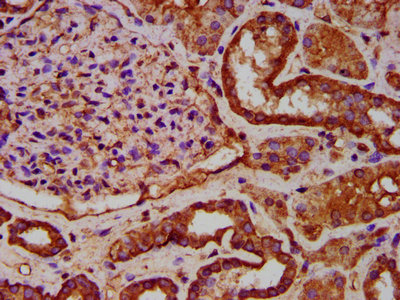
The antibody against ELP1 was raised in rabbit using the Recombinant Human Elongator complex protein 1 protein (1107-1258AA) as the immunogen. This antibody exists as a non-conjugated isotype IgG, purified by protein G with a purity greater than 95%. This antibody has been validated on ELISA, WB, IHC, IF, IP.

ADC-05146A

The antibody against ELP1 was raised in rabbit using the Recombinant Human Elongator complex protein 1 protein (1107-1258AA) as the immunogen. This antibody exists as a non-conjugated isotype IgG, purified by protein G with a purity greater than 95%. This antibody has been validated on ELISA, WB, IHC, IF, IP.

$299.00

Number
Order Exclusive Products Now

Request a Quote
High Purity LevelsPrecision and ReliabilityCustomization Options

Specifications


Cat.No ADC-05146A ClonalityPolyclonal
Host SpeciesRabbitTarget NameELP1
FormLiquidSpecies ReactivityHuman
IsotypeIgGStorage Buffer0.01M PBS, 0.03% Proclin 300; Constituents: 50% Glycerol, PH 7.4
Purification Method>95%, Protein G purifiedConjugateNon-conjugated
ApplicationELISA, IF, IHC, WB, IPStorageUpon receipt

Immunogen Information


Immunogen DescriptionRecombinant Human Elongator complex protein 1 protein (1107-1258AA)Target SpeciesHuman
Immunogen SequenceComplete sequences for the immunogen, target protein, and peptides are available upon request.Uniprot IDO95163
Background Information
  • Uniprot Id

    O95163

  • Target Species

    Human

  • Target Name

    ELP1

  • Target Full Name

    Elongator complex protein 1

  • Target Function

    Component of the RNA polymerase II elongator complex, a multiprotein complex associated with the RNA polymerase II (Pol II) holoenzyme, and which is involved in transcriptional elongation. The elongator complex catalyzes formation of carboxymethyluridine in the wobble base at position 34 in tRNAs. Involved in neurogenesis. Regulates the migration and branching of projection neurons in the developing cerebral cortex, through a process depending on alpha-tubulin acetylation. May act as a scaffold protein that may assemble active IKK-MAP3K14 complexes (IKKA, IKKB and MAP3K14/NIK).

  • Target Involvement

    Neuropathy, hereditary sensory and autonomic, 3 (HSAN3)

  • Target Subcellular Location

    Cytoplasm. Nucleus.

  • Target Protein Families

    ELP1/IKA1 family

  • Target Synonyms

    DKFZp781H1425; DYS; Dysautonomia (Riley Day syndrome hereditary sensory autonomic neuropathy type III); Elongator complex protein 1; ELP 1; ELP1; ELP1_HUMAN; FD; FLJ12497; IKAP; IkappaB kinase complex associated protein; IkappaB kinase complex-associated protein; ikbkap; IKI 3; IKI3; IKK complex associated protein; IKK complex-associated protein; Inhibitor of kappa light polypeptide gene enhancer in B cells kinase complex associated protein; OTTHUMP00000063889; p150; TOT 1; TOT1

  • Target Background

    The protein encoded by this gene is a scaffold protein and a regulator for three different kinases involved in proinflammatory signaling. The encoded protein can bind NF-kappa-B-inducing kinase and I-kappa-B kinases through separate domains and assemble them into an active kinase complex. Mutations in this gene have been associated with familial dysautonomia. Alternative splicing results in multiple transcript variants encoding different isoforms.

Inquire Rabbit anti-Human ELP1 Polyclonal Antibody Now


AbTriva respects your privacy and protects your personal data in accordance with AbTriva. For more information, please see our data protection statement. *

Notification