-
Chinese (Simplified)
-
English
-
German
-
Korean
-
Spanish
Chinese (Simplified)
English
German
Korean
Spanish
Sign up for an account to enjoy easy online shopping and instant order tracking.
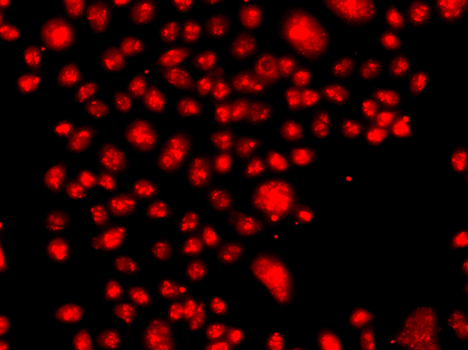
The antibody against FANCM was raised in Rabbit using the recombinant fusion protein containing a sequence corresponding to amino acids 390-660 of human FANCM (NP_065988.1) as the immunogen. The polyclonal antibody exists as a isotype IgG, by affinity purification. This antibody has been validated on WB, IF/ICC, ELISA.
| Cat.No | ADA-02408A | Clonality | Polyclonal |
|---|---|---|---|
| Host Species | Rabbit | Target Name | FANCM |
| Target Synonyms | POF15; SPGF28; FAAP250; KIAA1596; FANCM | Form | Liquid |
| Species Reactivity | Human | Isotype | IgG |
| Storage Buffer | 50% Glycerol, PBS with 0.02% sodium azide, pH7.3. | Purification Method | Affinity purification |
| Application | ELISA, WB, IF/ICC |
| Immunogen Description | Recombinant fusion protein containing a sequence corresponding to amino acids 390-660 of human FANCM (NP_065988.1). | Target Species | Human |
|---|---|---|---|
| Uniprot ID | Q8IYD8 | Immunogen Sequence |
Uniprot Id
Q8IYD8
Target Species
Human
Target Name
FANCM
Target Full Name
Fanconi anemia group M protein
Target Function
DNA-dependent ATPase component of the Fanconi anemia (FA) core complex. Required for the normal activation of the FA pathway, leading to monoubiquitination of the FANCI-FANCD2 complex in response to DNA damage, cellular resistance to DNA cross-linking drugs, and prevention of chromosomal breakage. In complex with CENPS and CENPX, binds double-stranded DNA (dsDNA), fork-structured DNA (fsDNA) and Holliday junction substrates. Its ATP-dependent DNA branch migration activity can process branched DNA structures such as a movable replication fork. This activity is strongly stimulated in the presence of CENPS and CENPX. In complex with FAAP24, efficiently binds to single-strand DNA (ssDNA), splayed-arm DNA, and 3'-flap substrates. In vitro, on its own, strongly binds ssDNA oligomers and weakly fsDNA, but does not bind to dsDNA.
Target Subcellular Location
Nucleus.
Target Protein Families
DEAD box helicase family, DEAH subfamily, FANCM sub-subfamily
Target Tissue Specificity
Expressed in germ cells of fetal and adult ovaries. In fetal ovaries, it is present in oogonia but expression is stronger in pachytene stage oocytes. Expressed in oocytes arrested at the diplotene stage of prophase I during the last trimester of pregnancy
Target Synonyms
FANCM; KIAA1596Fanconi anemia group M protein; Protein FACM; EC 3.6.4.13; ATP-dependent RNA helicase FANCM; Fanconi anemia-associated polypeptide of 250 kDa; FAAP250; Protein Hef ortholog
Target Background
The Fanconi anemia complementation group (FANC) currently includes FANCA, FANCB, FANCC, FANCD1 (also called BRCA2), FANCD2, FANCE, FANCF, FANCG, FANCI, FANCJ (also called BRIP1), FANCL, FANCM and FANCN (also called PALB2). The previously defined group FANCH is the same as FANCA. Fanconi anemia is a genetically heterogeneous recessive disorder characterized by cytogenetic instability, hypersensitivity to DNA crosslinking agents, increased chromosomal breakage, and defective DNA repair. The members of the Fanconi anemia complementation group do not share sequence similarity; they are related by their assembly into a common nuclear protein complex. This gene encodes the protein for complementation group M. Alternative splicing results in multiple transcript variants.
Notification