-
Chinese (Simplified)
-
English
-
German
-
Korean
-
Spanish
Chinese (Simplified)
English
German
Korean
Spanish
Sign up for an account to enjoy easy online shopping and instant order tracking.
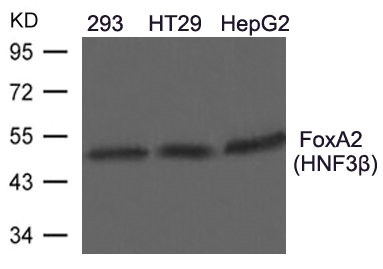
The antibody against FOXA2 was raised in rabbit using the Peptide sequence around aa.435~439( A-S-P-L-A) derived from Human FoxA2(HNF3b). as the immunogen. Antibodies were produced by immunizing rabbits with synthetic peptide and KLH conjugates. Antibodies were purified by affinity-chromatography using epitope-specific peptide. This antibody has been validated on ELISA, WB.
$297.00
| Cat.No | ADC-43138A | Clonality | Polyclonal |
|---|---|---|---|
| Host Species | Rabbit | Target Name | FOXA2 |
| Form | Liquid | Species Reactivity | Human |
| Storage Buffer | PH 7.4, 0.02% sodium azide and 50% glycerol., 150mM NaCl, Supplied at 1.0mg/mL in phosphate buffered saline (without Mg2+ and Ca2+) | Purification Method | Antibodies were produced by immunizing rabbits with synthetic peptide and KLH conjugates. Antibodies were purified by affinity-chromatography using epitope-specific peptide. |
| Application | ELISA, WB | Storage | Upon receipt |
| Immunogen Description | Peptide sequence around aa.435~439( A-S-P-L-A) derived from Human FoxA2(HNF3b). | Target Species | Human |
|---|---|---|---|
| Immunogen Sequence | Complete sequences for the immunogen, target protein, and peptides are available upon request. | Uniprot ID | Q9Y261 |
Uniprot Id
Q9Y261
Target Species
Human
Target Name
FOXA2
Target Full Name
Hepatocyte nuclear factor 3-beta
Target Function
Transcription factor that is involved in embryonic development, establishment of tissue-specific gene expression and regulation of gene expression in differentiated tissues. Is thought to act as a 'pioneer' factor opening the compacted chromatin for other proteins through interactions with nucleosomal core histones and thereby replacing linker histones at target enhancer and/or promoter sites. Binds DNA with the consensus sequence 5'-[AC]A[AT]T[AG]TT[GT][AG][CT]T[CT]-3'. In embryonic development is required for notochord formation. Involved in the development of multiple endoderm-derived organ systems such as the liver, pancreas and lungs; FOXA1 and FOXA2 seem to have at least in part redundant roles. Originally described as a transcription activator for a number of liver genes such as AFP, albumin, tyrosine aminotransferase, PEPCK, etc. Interacts with the cis-acting regulatory regions of these genes. Involved in glucose homeostasis; regulates the expression of genes important for glucose sensing in pancreatic beta-cells and glucose homeostasis. Involved in regulation of fat metabolism. Binds to fibrinogen beta promoter and is involved in IL6-induced fibrinogen beta transcriptional activation.
Target Subcellular Location
Nucleus. Cytoplasm. Note=Shuttles between the nucleus and cytoplasm in a CRM1-dependent manner; in response to insulin signaling via AKT1 is exported from the nucleus.
Target Synonyms
Forkhead box A2; Forkhead box protein A2; FOX A2; foxa2; FOXA2_HUMAN; Hepatic nuclear factor 3 beta; Hepatocyte nuclear factor 3; Hepatocyte nuclear factor 3 beta; Hepatocyte nuclear factor 3-beta; HNF 3B; HNF-3-beta; HNF-3B; HNF3B; MGC19807; TCF 3B; TCF-3B; TCF3B; Transcription factor 3B
Target Background
This gene encodes a member of the forkhead class of DNA-binding proteins. These hepatocyte nuclear factors are transcriptional activators for liver-specific genes such as albumin and transthyretin, and they also interact with chromatin. Similar family members in mice have roles in the regulation of metabolism and in the differentiation of the pancreas and liver. This gene has been linked to sporadic cases of maturity-onset diabetes of the young. Transcript variants encoding different isoforms have been identified for this gene.
Notification