• Contact info@abtriva.com for inquiries and orders.
  • Chinese (Simplified)

  • English

  • German

  • Korean

  • Spanish

United States (English / $ USD)

Rabbit anti-Human FOXP2 Polyclonal Antibody

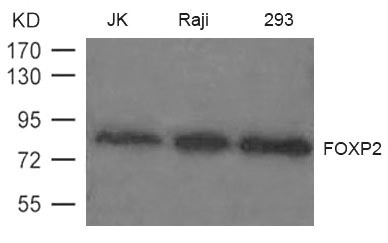
The antibody against FOXP2 was raised in rabbit using the Peptide sequence around aa.707~711(E-E-P-L-S) derived from Human FOXP2. as the immunogen. Antibodies were produced by immunizing rabbits with synthetic peptide and KLH conjugates. Antibodies were purified by affinity-chromatography using epitope-specific peptide. This antibody has been validated on ELISA, WB.

ADC-43186A

The antibody against FOXP2 was raised in rabbit using the Peptide sequence around aa.707~711(E-E-P-L-S) derived from Human FOXP2. as the immunogen. Antibodies were produced by immunizing rabbits with synthetic peptide and KLH conjugates. Antibodies were purified by affinity-chromatography using epitope-specific peptide. This antibody has been validated on ELISA, WB.

$297.00

Number
Order Exclusive Products Now

Request a Quote
High Purity LevelsPrecision and ReliabilityCustomization Options

Specifications


Cat.No ADC-43186A ClonalityPolyclonal
Host SpeciesRabbitTarget NameFOXP2
FormLiquidSpecies ReactivityHuman, Mouse
Storage BufferPH 7.4, 0.02% sodium azide and 50% glycerol., 150mM NaCl, Supplied at 1.0mg/mL in phosphate buffered saline (without Mg2+ and Ca2+)Purification MethodAntibodies were produced by immunizing rabbits with synthetic peptide and KLH conjugates. Antibodies were purified by affinity-chromatography using epitope-specific peptide.
ApplicationELISA, WBStorageUpon receipt

Immunogen Information


Immunogen DescriptionPeptide sequence around aa.707~711(E-E-P-L-S) derived from Human FOXP2.Target SpeciesHuman
Immunogen SequenceComplete sequences for the immunogen, target protein, and peptides are available upon request.Uniprot IDO15409
Background Information
  • Uniprot Id

    O15409

  • Target Species

    Human

  • Target Name

    FOXP2

  • Target Full Name

    Forkhead box protein P2

  • Target Function

    Transcriptional repressor that may play a role in the specification and differentiation of lung epithelium. May also play a role in developing neural, gastrointestinal and cardiovascular tissues. Can act with CTBP1 to synergistically repress transcription but CTPBP1 is not essential. Plays a role in synapse formation by regulating SRPX2 levels. Involved in neural mechanisms mediating the development of speech and language.

  • Target Involvement

    Speech-language disorder 1 (SPCH1)

  • Target Subcellular Location

    Nucleus.

  • Target Tissue Specificity

    Isoform 1 and isoform 6 are expressed in adult and fetal brain, caudate nucleus and lung.

  • Target Synonyms

    CAG repeat protein 44; CAGH44 ; DKFZp686H1726; Forkhead box P2 ; Forkhead box protein P2; forkhead/winged-helix transcription factor; FOX P2; FOXP2; FOXP2_HUMAN; HGNC11222 ; HGNC11956 ; SPCH 1; SPCH1 ; TNRC 10; TNRC10 ; trinucleotide repeat containing 10; Trinucleotide repeat containing gene 10 protein; Trinucleotide repeat-containing gene 10 protein

  • Target Background

    This gene encodes a member of the forkhead/winged-helix (FOX) family of transcription factors. It is expressed in fetal and adult brain as well as in several other organs such as the lung and gut. The protein product contains a FOX DNA-binding domain and a large polyglutamine tract and is an evolutionarily conserved transcription factor, which may bind directly to approximately 300 to 400 gene promoters in the human genome to regulate the expression of a variety of genes. This gene is required for proper development of speech and language regions of the brain during embryogenesis, and may be involved in a variety of biological pathways and cascades that may ultimately influence language development. Mutations in this gene cause speech-language disorder 1 (SPCH1), also known as autosomal dominant speech and language disorder with orofacial dyspraxia. Multiple alternative transcripts encoding different isoforms have been identified in this gene.

Inquire Rabbit anti-Human FOXP2 Polyclonal Antibody Now


AbTriva respects your privacy and protects your personal data in accordance with AbTriva. For more information, please see our data protection statement. *

Notification