-
Chinese (Simplified)
-
English
-
German
-
Korean
-
Spanish
Chinese (Simplified)
English
German
Korean
Spanish
Sign up for an account to enjoy easy online shopping and instant order tracking.
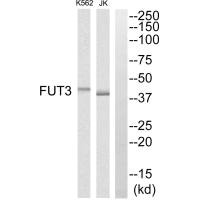
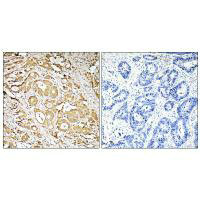
The antibody against FUT3 was raised in rabbit using the Synthesized peptide derived from internal of Human FUT3. as the immunogen. The antibody was affinity-purified from rabbit antiserum by affinity-chromatography using epitope-specific immunogen. This antibody has been validated on ELISA, WB, IHC.
$297.00
| Cat.No | ADC-41229A | Clonality | Polyclonal |
|---|---|---|---|
| Host Species | Rabbit | Target Name | FUT3 |
| Form | Liquid | Species Reactivity | Human |
| Storage Buffer | PH 7.4, 0.02% sodium azide and 50% glycerol., 150mM NaCl, Rabbit IgG in phosphate buffered saline (without Mg2+ and Ca2+) | Purification Method | The antibody was affinity-purified from rabbit antiserum by affinity-chromatography using epitope-specific immunogen. |
| Application | ELISA, IHC, WB | Storage | Upon receipt |
| Immunogen Description | Synthesized peptide derived from internal of Human FUT3. | Target Species | Human |
|---|---|---|---|
| Immunogen Sequence | Complete sequences for the immunogen, target protein, and peptides are available upon request. | Uniprot ID | P21217 |
Uniprot Id
P21217
Target Species
Human
Target Name
FUT3
Target Full Name
3-galactosyl-N-acetylglucosaminide 4-alpha-L-fucosyltransferase FUT3
Target Function
Catalyzes the transfer of L-fucose, from a guanosine diphosphate-beta-L-fucose, to both the subterminal N-acetyl glucosamine (GlcNAc) of type 1 chain (beta-D-Gal-(1->3)-beta-D-GlcNAc) glycolipids and oligosaccharides via an alpha(1,4) linkage, and the subterminal glucose (Glc) or GlcNAc of type 2 chain (beta-D-Gal-(1->4)-beta-D-GlcNAc) oligosaccharides via an alpha(1,3) linkage, independently of the presence of terminal alpha-L-fucosyl-(1,2) moieties on the terminal galactose of these acceptors and participates in the blood groups Lewis determination and expression of Lewis a (Le(a)), lewis b (Le(b)), Lewis x/SSEA-1 (Le(x)) and lewis y (Le(y)) antigens. Also catalyzes the transfer of L-fucose to subterminal GlcNAc of sialyl- and disialyl-lactotetraosylceramide to produce sialyl Lewis a (sLe(a)) and disialyl Lewis a via an alpha(1,4) linkage and therefore may regulate cell surface sialyl Lewis a expression and consequently regulates adhesive properties to E-selectin, cell proliferation and migration. Catalyzes the transfer of an L-fucose to 3'-sialyl-N-acetyllactosamine by an alpha(1,3) linkage, which allows the formation of sialyl-Lewis x structure and therefore may regulate the sialyl-Lewis x surface antigen expression and consequently adhesive properties to E-selectin. Prefers type 1 chain over type 2 acceptors. Type 1 tetrasaccharide is a better acceptor than type 1 disaccharide suggesting that a beta anomeric configuration of GlcNAc in the substrate is preferred. Lewis-positive (Le(+)) individuals have an active enzyme while Lewis-negative (Le(-)) individuals have an inactive enzyme.
Target Subcellular Location
Golgi apparatus, Golgi stack membrane; Single-pass type II membrane protein. Note=Membrane-bound form in trans cisternae of Golgi.
Target Protein Families
Glycosyltransferase 10 family
Target Tissue Specificity
Highly expressed in stomach, colon, small intestine, lung and kidney and to a lesser extent in salivary gland, bladder, uterus and liver.
Target Synonyms
FUT3; FT3B; LE; 3-galactosyl-N-acetylglucosaminide 4-alpha-L-fucosyltransferase FUT3; Alpha-3-fucosyltransferase FUT3; Blood group Lewis alpha-4-fucosyltransferase; Lewis FT; Fucosyltransferase 3; Fucosyltransferase III; FucT-III
Target Background
The Lewis histo-blood group system comprises a set of fucosylated glycosphingolipids that are synthesized by exocrine epithelial cells and circulate in body fluids. The glycosphingolipids function in embryogenesis, tissue differentiation, tumor metastasis, inflammation, and bacterial adhesion. They are secondarily absorbed to red blood cells giving rise to their Lewis phenotype. This gene is a member of the fucosyltransferase family, which catalyzes the addition of fucose to precursor polysaccharides in the last step of Lewis antigen biosynthesis. It encodes an enzyme with alpha(1, 3)-fucosyltransferase and alpha(1, 4)-fucosyltransferase activities. Mutations in this gene are responsible for the majority of Lewis antigen-negative phenotypes. Differences in the expression of this gene are associated with host susceptibility to viral infection.
Notification