-
Chinese (Simplified)
-
English
-
German
-
Korean
-
Spanish
Chinese (Simplified)
English
German
Korean
Spanish
Sign up for an account to enjoy easy online shopping and instant order tracking.
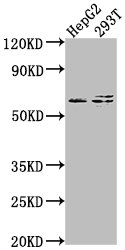
The antibody against FZD7 was raised in rabbit using the Recombinant Human Frizzled-7 protein (161-239AA) as the immunogen. This antibody exists as a non-conjugated isotype IgG, purified by protein G with a purity greater than 95%. This antibody has been validated on ELISA, WB, IHC.
$299.00
| Cat.No | ADC-01686A | Clonality | Polyclonal |
|---|---|---|---|
| Host Species | Rabbit | Target Name | FZD7 |
| Target Synonyms | FZD7; Frizzled-7; Fz-7; hFz7; FzE3 | Form | Liquid |
| Species Reactivity | Human | Isotype | IgG |
| Storage Buffer | 0.01M PBS, 0.03% Proclin 300; Constituents: 50% Glycerol, PH 7.4 | Purification Method | >95%, Protein G purified |
| Conjugate | Non-conjugated | Application | ELISA, IHC, WB |
| Storage | Upon receipt |
| Immunogen Description | Recombinant Human Frizzled-7 protein (161-239AA) | Target Species | Human |
|---|---|---|---|
| Immunogen Sequence | Complete sequences for the immunogen, target protein, and peptides are available upon request. | Uniprot ID | O75084 |
Uniprot Id
O75084
Target Species
Human
Target Name
FZD7
Target Full Name
Frizzled-7
Target Function
Receptor for Wnt proteins. Most frizzled receptors are coupled to the beta-catenin canonical signaling pathway, which leads to the activation of disheveled proteins, inhibition of GSK-3 kinase, nuclear accumulation of beta-catenin and activation of Wnt target genes. A second signaling pathway involving PKC and calcium fluxes has been seen for some family members, but it is not yet clear if it represents a distinct pathway or if it can be integrated in the canonical pathway, as PKC seems to be required for Wnt-mediated inactivation of GSK-3 kinase. Both pathways seem to involve interactions with G-proteins. Activation by WNT8 induces expression of beta-catenin target genes. Following ligand activation, binds to CCDC88C/DAPLE which displaces DVL1 from FZD7 and leads to inhibition of canonical Wnt signaling, activation of G-proteins by CCDC88C and triggering of non-canonical Wnt responses. May be involved in transduction and intercellular transmission of polarity information during tissue morphogenesis and/or in differentiated tissues.; (Microbial infection) Acts as a receptor for C.difficile toxin TcdB in the colonic epithelium.
Target Subcellular Location
Cell membrane; Multi-pass membrane protein. Endosome membrane; Multi-pass membrane protein.
Target Protein Families
G-protein coupled receptor Fz/Smo family
Target Tissue Specificity
High expression in adult skeletal muscle and fetal kidney, followed by fetal lung, adult heart, brain, and placenta. Specifically expressed in squamous cell esophageal carcinomas.
Target Synonyms
FZD7; Frizzled-7; Fz-7; hFz7; FzE3
Target Background
Members of the 'frizzled' gene family encode 7-transmembrane domain proteins that are receptors for Wnt signaling proteins. The FZD7 protein contains an N-terminal signal sequence, 10 cysteine residues typical of the cysteine-rich extracellular domain of Fz family members, 7 putative transmembrane domains, and an intracellular C-terminal tail with a PDZ domain-binding motif. FZD7 gene expression may downregulate APC function and enhance beta-catenin-mediated signals in poorly differentiated human esophageal carcinomas.
Notification