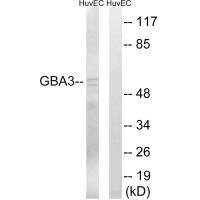
-
Chinese (Simplified)
-
English
-
German
-
Korean
-
Spanish
Chinese (Simplified)
English
German
Korean
Spanish
Sign up for an account to enjoy easy online shopping and instant order tracking.
The antibody against GBA3 was raised in rabbit using the Synthesized peptide derived from internal of Human GBA3. as the immunogen. The antibody was affinity-purified from rabbit antiserum by affinity-chromatography using epitope-specific immunogen. This antibody has been validated on ELISA, WB.
$297.00
| Cat.No | ADC-41282A | Clonality | Polyclonal |
|---|---|---|---|
| Host Species | Rabbit | Target Name | GBA3 |
| Form | Liquid | Species Reactivity | Human |
| Storage Buffer | PH 7.4, 0.02% sodium azide and 50% glycerol., 150mM NaCl, Rabbit IgG in phosphate buffered saline (without Mg2+ and Ca2+) | Purification Method | The antibody was affinity-purified from rabbit antiserum by affinity-chromatography using epitope-specific immunogen. |
| Application | ELISA, WB | Storage | Upon receipt |
| Immunogen Description | Synthesized peptide derived from internal of Human GBA3. | Target Species | Human |
|---|---|---|---|
| Immunogen Sequence | Complete sequences for the immunogen, target protein, and peptides are available upon request. | Uniprot ID | Q9H227 |
Uniprot Id
Q9H227
Target Species
Human
Target Name
GBA3
Target Full Name
Cytosolic beta-glucosidase
Target Function
Neutral cytosolic beta-glycosidase with a broad substrate specificity that could play a role in the catabolism of glycosylceramides. Has a significant glucosylceramidase activity in vitro. However, that activity is relatively low and its significance in vivo is not clear. Also able to hydrolyze galactosylceramide/GalCer, glucosylsphingosine/GlcSph and galactosylsphingosine/GalSph. However, the in vivo relevance of these activities is unclear. It can also hydrolyze a broad variety of dietary glycosides including phytoestrogens, flavonols, flavones, flavanones and cyanogens in vitro and could therefore play a role in the metabolism of xenobiotics. Could also play a role in the catabolism of cytosolic sialyl free N-glycans.
Target Subcellular Location
Cytoplasm, cytosol.
Target Protein Families
Glycosyl hydrolase 1 family, Klotho subfamily
Target Tissue Specificity
Present in small intestine (at protein level). Expressed in liver, small intestine, colon, spleen and kidney. Down-regulated in renal cell carcinomas and hepatocellular carcinomas.
Target Research Area
Signal Transduction
Target Synonyms
CBG; CBGL1; Cytosolic beta glucosidase ; Cytosolic beta glucosidase like protein 1; Cytosolic beta-glucosidase; Cytosolic beta-glucosidase-like protein 1; GBA3; GBA3_HUMAN; GLUC; Glucosidase beta acid 3; Klotho related protein ; KLRP
Target Background
The protein encoded by this gene is a cytosolic enzyme that can hydrolyze several types of glycosides. The enzyme has its highest activity at neutral pH and is predominantly expressed in human liver, kidney, intestine, and spleen. This gene is a polymorphic pseudogene, with the most common allele being the functional allele that encodes the full-length protein. Some individuals contain a single nucleotide polymorphism that results in a premature stop codon in the coding region, and therefore this allele is pseudogenic due to the failure to produce a functional full-length protein. Alternative splicing of this gene results in multiple transcript variants.
Notification