-
Chinese (Simplified)
-
English
-
German
-
Korean
-
Spanish
Chinese (Simplified)
English
German
Korean
Spanish
Sign up for an account to enjoy easy online shopping and instant order tracking.
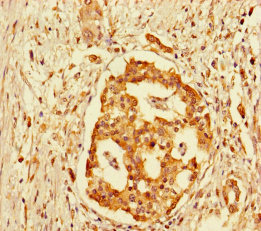
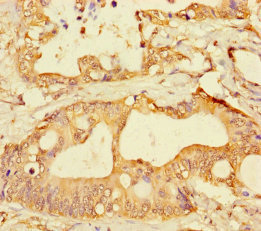
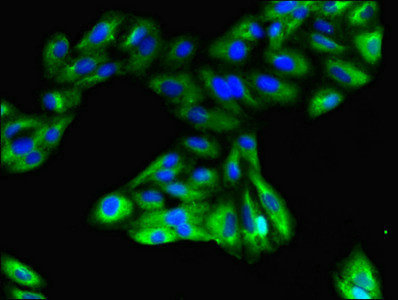
The antibody against GPR183 was raised in rabbit using the Recombinant Human G-protein coupled receptor 183 protein (1-31AA) as the immunogen. This antibody exists as a non-conjugated isotype IgG, purified by protein G with a purity greater than 95%. This antibody has been validated on ELISA, IHC, IF.
$299.00
| Cat.No | ADC-22014A | Clonality | Polyclonal |
|---|---|---|---|
| Host Species | Rabbit | Target Name | GPR183 |
| Target Synonyms | GPR183; EBI2; G-protein coupled receptor 183; Epstein-Barr virus-induced G-protein coupled receptor 2; EBV-induced G-protein coupled receptor 2; hEBI2 | Form | Liquid |
| Species Reactivity | Human | Isotype | IgG |
| Storage Buffer | 0.01M PBS, 0.03% Proclin 300; Constituents: 50% Glycerol, PH 7.4 | Purification Method | >95%, Protein G purified |
| Conjugate | Non-conjugated | Application | ELISA, IF, IHC |
| Storage | Upon receipt |
| Immunogen Description | Recombinant Human G-protein coupled receptor 183 protein (1-31AA) | Target Species | Human |
|---|---|---|---|
| Immunogen Sequence | Complete sequences for the immunogen, target protein, and peptides are available upon request. | Uniprot ID | P32249 |
Uniprot Id
P32249
Target Species
Human
Target Name
GPR183
Target Full Name
G-protein coupled receptor 183
Target Function
G-protein coupled receptor expressed in lymphocytes that acts as a chemotactic receptor for B-cells, T-cells, splenic dendritic cells, monocytes/macrophages and astrocytes. Receptor for oxysterol 7-alpha,25-dihydroxycholesterol (7-alpha,25-OHC) and other related oxysterols. Mediates cell positioning and movement of a number of cells by binding the 7-alpha,25-OHC ligand that forms a chemotactic gradient. Binding of 7-alpha,25-OHC mediates the correct localization of B-cells during humoral immune responses. Guides B-cell movement along the B-cell zone-T-cell zone boundary and later to interfollicular and outer follicular regions. Its specific expression during B-cell maturation helps position B-cells appropriately for mounting T-dependent antibody responses. Collaborates with CXCR5 to mediate B-cell migration; probably by forming a heterodimer with CXCR5 that affects the interaction between of CXCL13 and CXCR5. Also acts as a chemotactic receptor for some T-cells upon binding to 7-alpha,25-OHC ligand. Promotes follicular helper T (Tfh) cells differentiation by positioning activated T-cells at the follicle-T-zone interface, promoting contact of newly activated CD4 T-cells with activated dendritic cells and exposing them to Tfh-cell-promoting inducible costimulator (ICOS) ligand. Expression in splenic dendritic cells is required for their homeostasis, localization and ability to induce B- and T-cell responses: GPR183 acts as a chemotactic receptor in dendritic cells that mediates the accumulation of CD4(+) dendritic cells in bridging channels. Regulates migration of astrocytes and is involved in communication between astrocytes and macrophages. Promotes osteoclast precursor migration to bone surfaces. Signals constitutively through G(i)-alpha, but not G(s)-alpha or G(q)-alpha. Signals constitutively also via MAPK1/3 (ERK1/2).
Target Subcellular Location
Cell membrane; Multi-pass membrane protein.
Target Protein Families
G-protein coupled receptor 1 family
Target Tissue Specificity
Expressed abundantly in lymphoid tissues such as spleen and lymph node, and in B- and T-lymphocytes. Also highly expressed in lung, heart and gastrointestinal tract, and weakly expressed in the urogenital system and brain. Expressed in astrocytes.
Target Synonyms
GPR183; EBI2; G-protein coupled receptor 183; Epstein-Barr virus-induced G-protein coupled receptor 2; EBV-induced G-protein coupled receptor 2; hEBI2
Notification