-
Chinese (Simplified)
-
English
-
German
-
Korean
-
Spanish
Chinese (Simplified)
English
German
Korean
Spanish
Sign up for an account to enjoy easy online shopping and instant order tracking.
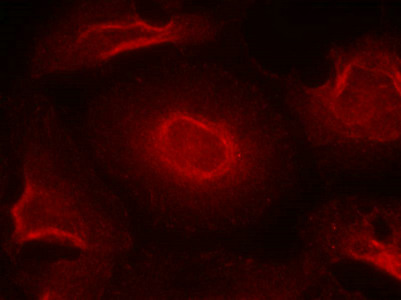
The antibody against GRIN2B was raised in rabbit using the Peptide sequence around aa.1472~1476 (H-V-Y-E-K) derived from Human NMDAR2B. as the immunogen. Antibodies were produced by immunizing rabbits with synthetic peptide and KLH conjugates. Antibodies were purified by affinity-chromatography using epitope-specific peptide. This antibody has been validated on ELISA, IF.
$297.00
| Cat.No | ADC-43421A | Clonality | Polyclonal |
|---|---|---|---|
| Host Species | Rabbit | Target Name | GRIN2B |
| Target Synonyms | ionotropic | Form | Liquid |
| Species Reactivity | Human, Mouse, Rat | Storage Buffer | PH 7.4, 0.02% sodium azide and 50% glycerol., 150mM NaCl, Supplied at 1.0mg/mL in phosphate buffered saline (without Mg2+ and Ca2+) |
| Purification Method | Antibodies were produced by immunizing rabbits with synthetic peptide and KLH conjugates. Antibodies were purified by affinity-chromatography using epitope-specific peptide. | Application | ELISA, IF |
| Storage | Upon receipt |
| Immunogen Description | Peptide sequence around aa.1472~1476 (H-V-Y-E-K) derived from Human NMDAR2B. | Target Species | Human |
|---|---|---|---|
| Immunogen Sequence | Complete sequences for the immunogen, target protein, and peptides are available upon request. | Uniprot ID | Q13224 |
Uniprot Id
Q13224
Target Species
Human
Target Name
GRIN2B
Target Full Name
Glutamate receptor ionotropic, NMDA 2B
Target Function
Component of NMDA receptor complexes that function as heterotetrameric, ligand-gated ion channels with high calcium permeability and voltage-dependent sensitivity to magnesium. Channel activation requires binding of the neurotransmitter glutamate to the epsilon subunit, glycine binding to the zeta subunit, plus membrane depolarization to eliminate channel inhibition by Mg(2+). Sensitivity to glutamate and channel kinetics depend on the subunit composition. In concert with DAPK1 at extrasynaptic sites, acts as a central mediator for stroke damage. Its phosphorylation at Ser-1303 by DAPK1 enhances synaptic NMDA receptor channel activity inducing injurious Ca2+ influx through them, resulting in an irreversible neuronal death. Contributes to neural pattern formation in the developing brain. Plays a role in long-term depression (LTD) of hippocampus membrane currents and in synaptic plasticity.
Target Involvement
Mental retardation, autosomal dominant 6, with or without seizures (MRD6); Epileptic encephalopathy, early infantile, 27 (EIEE27)
Target Subcellular Location
Cell membrane; Multi-pass membrane protein. Cell junction, synapse, postsynaptic cell membrane; Multi-pass membrane protein. Late endosome. Lysosome. Cytoplasm, cytoskeleton.
Target Protein Families
Glutamate-gated ion channel (TC 1.A.10.1) family, NR2B/GRIN2B subfamily
Target Tissue Specificity
Primarily found in the fronto-parieto-temporal cortex and hippocampus pyramidal cells, lower expression in the basal ganglia.
Target Synonyms
AW490526; EIEE27; Glutamate [NMDA] receptor subunit epsilon 2; Glutamate [NMDA] receptor subunit epsilon-2; Glutamate Receptor Ionotropic N Methyl D Aspartate 2B; Glutamate Receptor Ionotropic N Methyl D Aspartate subunit 2B; Glutamate receptor ionotropic NMDA2B; Glutamate receptor subunit epsilon 2; Glutamate receptor, ionotropic, NMDA2B (epsilon 2); GRIN 2B; GRIN2B; hNR 3; hNR3; MGC142178; MGC142180; MRD6; N methyl D asparate receptor channel subunit epsilon 2; N methyl D aspartate receptor subtype 2B; N methyl D aspartate receptor subunit 2B; N methyl D aspartate receptor subunit 3; N-methyl D-aspartate receptor subtype 2B; N-methyl-D-aspartate receptor subunit 3; NMDA NR2B; NMDA R2B; NMDAR2B; NMDE2; NMDE2_HUMAN; NME2; NR2B; NR3
Target Background
This gene encodes a member of the N-methyl-D-aspartate (NMDA) receptor family within the ionotropic glutamate receptor superfamily. The encoded protein is a subunit of the NMDA receptor ion channel which acts as an agonist binding site for glutamate. The NMDA receptors mediate a slow calcium-permeable component of excitatory synaptic transmission in the central nervous system. The NMDA receptors are heterotetramers of seven genetically encoded, differentially expressed subunits including NR1 (GRIN1), NR2 (GRIN2A, GRIN2B, GRIN2C, or GRIN2D) and NR3 (GRIN3A or GRIN3B). The early expression of this gene in development suggests a role in brain development, circuit formation, synaptic plasticity, and cellular migration and differentiation. Naturally occurring mutations within this gene are associated with neurodevelopmental disorders including autism spectrum disorder, attention deficit hyperactivity disorder, epilepsy, and schizophrenia.
Notification