-
Chinese (Simplified)
-
English
-
German
-
Korean
-
Spanish
Chinese (Simplified)
English
German
Korean
Spanish
Sign up for an account to enjoy easy online shopping and instant order tracking.
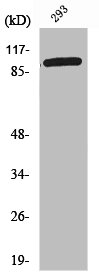
The antibody against GTF2IRD1 was raised in rabbit using the Synthesized peptide derived from the N-terminal region of Human WBSCR11. as the immunogen. This antibody exists as a non-conjugated isotype IgG. The antibody was affinity-purified from rabbit antiserum by affinity-chromatography using epitope-specific immunogen. This antibody has been validated on WB, IHC, ELISA.
$167.00
| Cat.No | ADC-37371A | Clonality | Polyclonal |
|---|---|---|---|
| Host Species | Rabbit | Target Name | GTF2IRD1 |
| Form | Liquid | Species Reactivity | Human, Mouse, Rat |
| Isotype | IgG | Storage Buffer | 0.5% BSA and 0.02% sodium azide., Liquid in PBS containing 50% glycerol |
| Purification Method | The antibody was affinity-purified from rabbit antiserum by affinity-chromatography using epitope-specific immunogen. | Conjugate | Non-conjugated |
| Application | ELISA, IHC, WB | Storage | Upon receipt |
| Immunogen Description | Synthesized peptide derived from the N-terminal region of Human WBSCR11. | Target Species | Human |
|---|---|---|---|
| Immunogen Sequence | Complete sequences for the immunogen, target protein, and peptides are available upon request. | Uniprot ID | Q9UHL9 |
Uniprot Id
Q9UHL9
Target Species
Human
Target Name
GTF2IRD1
Target Full Name
General transcription factor II-I repeat domain-containing protein 1
Target Function
May be a transcription regulator involved in cell-cycle progression and skeletal muscle differentiation. May repress GTF2I transcriptional functions, by preventing its nuclear residency, or by inhibiting its transcriptional activation. May contribute to slow-twitch fiber type specificity during myogenesis and in regenerating muscles. Binds troponin I slow-muscle fiber enhancer (USE B1). Binds specifically and with high affinity to the EFG sequences derived from the early enhancer of HOXC8.
Target Involvement
GTF2IRD1 is located in the Williams-Beuren syndrome (WBS) critical region. WBS results from a hemizygous deletion of several genes on chromosome 7q11.23, thought to arise as a consequence of unequal crossing over between highly homologous low-copy repeat sequences flanking the deleted region. Haploinsufficiency of GTF2IRD1 may be the cause of certain cardiovascular and musculo-skeletal abnormalities observed in the disease.
Target Subcellular Location
Nucleus.
Target Protein Families
TFII-I family
Target Tissue Specificity
Highly expressed in adult skeletal muscle, heart, fibroblast, bone and fetal tissues. Expressed at lower levels in all other tissues tested.
Target Synonyms
BEN; WBS; GTF3; RBAP2; CREAM1; MUSTRD1; WBSCR11; WBSCR12; hMusTRD1alpha1; GTF2IRD1
Target Background
The protein encoded by this gene contains five GTF2I-like repeats and each repeat possesses a potential helix-loop-helix (HLH) motif. It may have the ability to interact with other HLH-proteins and function as a transcription factor or as a positive transcriptional regulator under the control of Retinoblastoma protein. This gene plays a role in craniofacial and cognitive development and mutations have been associated with Williams-Beuren syndrome, a multisystem developmental disorder caused by deletion of multiple genes at 7q11.23. Alternative splicing results in multiple transcript variants.
Notification