-
Chinese (Simplified)
-
English
-
German
-
Korean
-
Spanish
Chinese (Simplified)
English
German
Korean
Spanish
Sign up for an account to enjoy easy online shopping and instant order tracking.
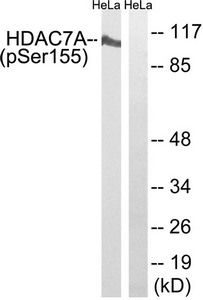
The antibody against HDAC7 was raised in rabbit using the Peptide sequence around phosphorylation site of Serine 155(T-V-S(p)-E-P) derived from Human HDAC7A. as the immunogen. Antibodies were produced by immunizing rabbits with synthetic phosphopeptide and KLH conjugates. Antibodies were purified by affinity-chromatography using epitope-specific phosphopeptide. Non-phospho specific antibodies were removed by chromatogramphy usi This antibody has been validated on ELISA, WB.
$360.00
| Cat.No | ADC-42664A | Clonality | Polyclonal |
|---|---|---|---|
| Host Species | Rabbit | Target Name | HDAC7 |
| Form | Liquid | Species Reactivity | Human, Mouse |
| Storage Buffer | PH 7.4, 0.02% sodium azide and 50% glycerol., 150mM NaCl, Rabbit IgG in phosphate buffered saline (without Mg2+ and Ca2+) | Application | ELISA, WB |
| Storage | Upon receipt |
| Immunogen Description | Peptide sequence around phosphorylation site of Serine 155(T-V-S(p)-E-P) derived from Human HDAC7A. | Target Species | Human |
|---|---|---|---|
| Immunogen Sequence | Complete sequences for the immunogen, target protein, and peptides are available upon request. | Uniprot ID | Q8WUI4 |
Uniprot Id
Q8WUI4
Target Species
Human
Target Name
HDAC7
Target Full Name
Histone deacetylase 7
Target Function
Responsible for the deacetylation of lysine residues on the N-terminal part of the core histones (H2A, H2B, H3 and H4). Histone deacetylation gives a tag for epigenetic repression and plays an important role in transcriptional regulation, cell cycle progression and developmental events. Histone deacetylases act via the formation of large multiprotein complexes. Involved in muscle maturation by repressing transcription of myocyte enhancer factors such as MEF2A, MEF2B and MEF2C. During muscle differentiation, it shuttles into the cytoplasm, allowing the expression of myocyte enhancer factors. May be involved in Epstein-Barr virus (EBV) latency, possibly by repressing the viral BZLF1 gene. Positively regulates the transcriptional repressor activity of FOXP3. Serves as a corepressor of RARA, causing its deacetylation and inhibition of RARE DNA element binding. In association with RARA, plays a role in the repression of microRNA-10a and thereby in the inflammatory response.
Target Subcellular Location
Nucleus. Cytoplasm. Note=In the nucleus, it associates with distinct subnuclear dot-like structures. Shuttles between the nucleus and the cytoplasm. Treatment with EDN1 results in shuttling from the nucleus to the perinuclear region. The export to cytoplasm depends on the interaction with the 14-3-3 protein YWHAE and is due to its phosphorylation.
Target Protein Families
Histone deacetylase family, HD type 2 subfamily
Target Synonyms
DKFZP586J0917; FLJ99588; HD 7a; HD7; HD7a; HDAC 7; HDAC 7A; Hdac7; HDAC7_HUMAN; HDAC7A; Histone deacetylase 7; Histone deacetylase 7A; OTTHUMP00000202813; OTTHUMP00000202814
Target Background
Histones play a critical role in transcriptional regulation, cell cycle progression, and developmental events. Histone acetylation/deacetylation alters chromosome structure and affects transcription factor access to DNA. The protein encoded by this gene has sequence homology to members of the histone deacetylase family. This gene is orthologous to mouse HDAC7 gene whose protein promotes repression mediated via the transcriptional corepressor SMRT. Alternatively spliced transcript variants encoding different isoforms have been found for this gene.
Notification