-
Chinese (Simplified)
-
English
-
German
-
Korean
-
Spanish
Chinese (Simplified)
English
German
Korean
Spanish
Sign up for an account to enjoy easy online shopping and instant order tracking.
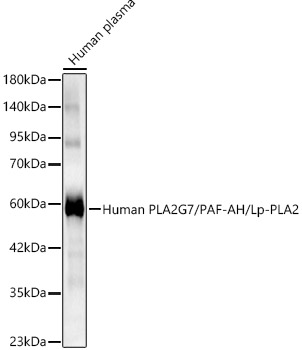
The antibody against Human PLA2G7/PAF-AH/Lp-PLA2 was raised in Rabbit using the recombinant fusion protein containing a sequence corresponding to amino acids 22-441 of human PLA2G7/PAF-AH/Lp-PLA2 (NP_005075.3) as the immunogen. The polyclonal antibody exists as a isotype IgG, by affinity purification. This antibody has been validated on WB, ELISA.
| Cat.No | ADA-08259A | Clonality | Polyclonal |
|---|---|---|---|
| Host Species | Rabbit | Target Name | Human PLA2G7/PAF-AH/Lp-PLA2 |
| Target Synonyms | PLA2G7; LDL-PLA2; LP-PLA2; PAFAD; PAFAH; phospholipase A2 group VII; Human PLA2G7/PAF-AH/Lp-PLA2 | Form | Liquid |
| Species Reactivity | Human, Mouse | Isotype | IgG |
| Storage Buffer | 50% Glycerol, PBS with 0.05% proclin300, pH7.3. | Purification Method | Affinity purification |
| Positive Samples | Human plasma | Application | ELISA, WB |
| Immunogen Description | Recombinant fusion protein containing a sequence corresponding to amino acids 22-441 of human PLA2G7/PAF-AH/Lp-PLA2 (NP_005075.3). | Target Species | Human |
|---|---|---|---|
| Uniprot ID | Q13093 | Immunogen Sequence |
Uniprot Id
Q13093
Target Species
Human
Target Name
PLA2G7
Target Full Name
Platelet-activating factor acetylhydrolase
Target Function
Lipoprotein-associated calcium-independent phospholipase A2 involved in phospholipid catabolism during inflammatory and oxidative stress response. At the lipid-aqueous interface, hydrolyzes the ester bond of fatty acyl group attached at sn-2 position of phospholipids (phospholipase A2 activity). Specifically targets phospholipids with a short-chain fatty acyl group at sn-2 position. Can hydrolyze phospholipids with long fatty acyl chains, only if they carry oxidized functional groups. Hydrolyzes and inactivates platelet-activating factor (PAF, 1-O-alkyl-2-acetyl-sn-glycero-3-phosphocholine), a potent proinflammatory signaling lipid that acts through PTAFR on various innate immune cells. Hydrolyzes oxidatively truncated phospholipids carrying an aldehyde group at omega position, preventing their accumulation in low-density lipoprotein (LDL) particles and uncontrolled proinflammatory effects. As part of high-density lipoprotein (HDL) particles, can hydrolyze phospholipids having long-chain fatty acyl hydroperoxides at sn-2 position and protect against potential accumulation of these oxylipins in the vascular wall. Catalyzes the release from membrane phospholipids of F2-isoprostanes, lipid biomarkers of cellular oxidative damage.
Target Involvement
Platelet-activating factor acetylhydrolase deficiency (PAFAD); Asthma (ASTHMA); Atopic hypersensitivity (ATOPY)
Target Subcellular Location
Secreted, extracellular space.
Target Protein Families
AB hydrolase superfamily, Lipase family
Target Tissue Specificity
Plasma. Secreted by macrophages (at protein level).
Target Synonyms
PLA2G7; LDL-PLA2; LP-PLA2; PAFAD; PAFAH; phospholipase A2 group VII; Human PLA2G7/PAF-AH/Lp-PLA2
Target Background
The protein encoded by this gene is a secreted enzyme that catalyzes the degradation of platelet-activating factor to biologically inactive products. Defects in this gene are a cause of platelet-activating factor acetylhydrolase deficiency. Two transcript variants encoding the same protein have been found for this gene.
Notification