-
Chinese (Simplified)
-
English
-
German
-
Korean
-
Spanish
Chinese (Simplified)
English
German
Korean
Spanish
Sign up for an account to enjoy easy online shopping and instant order tracking.
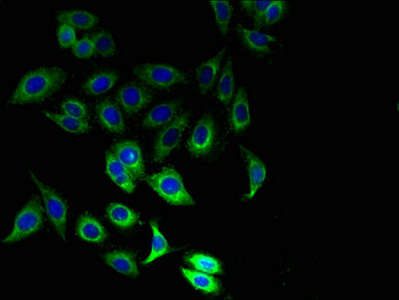
The antibody against IFITM1 was raised in rabbit using the Recombinant Human Interferon-induced transmembrane protein 1 protein (1-36AA) as the immunogen. This antibody exists as a non-conjugated isotype IgG, purified by protein G with a purity greater than 95%. This antibody has been validated on ELISA, WB, IF.
$299.00
| Cat.No | ADC-54428A | Clonality | Polyclonal |
|---|---|---|---|
| Host Species | Rabbit | Target Name | IFITM1 |
| Form | Liquid | Species Reactivity | Human |
| Isotype | IgG | Storage Buffer | 0.01M PBS, 0.03% Proclin 300; Constituents: 50% Glycerol, PH 7.4 |
| Purification Method | >95%, Protein G purified | Conjugate | Non-conjugated |
| Application | ELISA, IF, WB | Storage | Upon receipt |
| Immunogen Description | Recombinant Human Interferon-induced transmembrane protein 1 protein (1-36AA) | Target Species | Human |
|---|---|---|---|
| Immunogen Sequence | Complete sequences for the immunogen, target protein, and peptides are available upon request. | Uniprot ID | P13164 |
Uniprot Id
P13164
Target Species
Human
Target Name
IFITM1
Target Full Name
Interferon-induced transmembrane protein 1
Target Function
IFN-induced antiviral protein which inhibits the entry of viruses to the host cell cytoplasm, permitting endocytosis, but preventing subsequent viral fusion and release of viral contents into the cytosol. Active against multiple viruses, including influenza A virus, SARS coronaviruses (SARS-CoV and SARS-CoV-2), Marburg virus (MARV), Ebola virus (EBOV), Dengue virus (DNV), West Nile virus (WNV), human immunodeficiency virus type 1 (HIV-1) and hepatitis C virus (HCV). Can inhibit: influenza virus hemagglutinin protein-mediated viral entry, MARV and EBOV GP1,2-mediated viral entry and SARS-CoV and SARS-CoV-2 S protein-mediated viral entry. Also implicated in cell adhesion and control of cell growth and migration. Inhibits SARS-CoV-2 S protein-mediated syncytia formation. Plays a key role in the antiproliferative action of IFN-gamma either by inhibiting the ERK activation or by arresting cell growth in G1 phase in a p53-dependent manner. Acts as a positive regulator of osteoblast differentiation. In hepatocytes, IFITM proteins act in a coordinated manner to restrict HCV infection by targeting the endocytosed HCV virion for lysosomal degradation. IFITM2 and IFITM3 display anti-HCV activity that may complement the anti-HCV activity of IFITM1 by inhibiting the late stages of HCV entry, possibly in a coordinated manner by trapping the virion in the endosomal pathway and targeting it for degradation at the lysosome.
Target Subcellular Location
Cell membrane; Single-pass membrane protein. Lysosome membrane.
Target Protein Families
CD225/Dispanin family
Target Tissue Specificity
Bone (at protein level). Levels greatly elevated in colon cancer, cervical cancer, esophageal cancer and ovarian cancer. Expressed in glioma cell lines.
Target Research Area
Immunology
Target Synonyms
9-27; CD 225 ; CD 225 antigen; CD225; CD225 antigen; Dispanin subfamily A member 2a; DSPA2a; IFI 17; IFI17; IFITM1; IFM1_HUMAN; Interferon induced protein 17; interferon induced transmembrane protein 1 (9-27); Interferon induced transmembrane protein 1; Interferon inducible protein 9-27; Interferon-induced protein 17; Interferon-induced transmembrane protein 1; Interferon-inducible protein 9-27; Leu 13; Leu 13 antigen; Leu-13 antigen; LEU13
Target Background
Interferon-induced transmembrane (IFITM) proteins are a family of interferon induced antiviral proteins. The family contains five members, including IFITM1, IFITM2 and IFITM3 that belong to the CD225 superfamily. The protein encoded by this gene restricts cellular entry by diverse viral pathogens, such as influenza A virus, Ebola virus and Sars-CoV-2.
Notification