-
Chinese (Simplified)
-
English
-
German
-
Korean
-
Spanish
Chinese (Simplified)
English
German
Korean
Spanish
Sign up for an account to enjoy easy online shopping and instant order tracking.
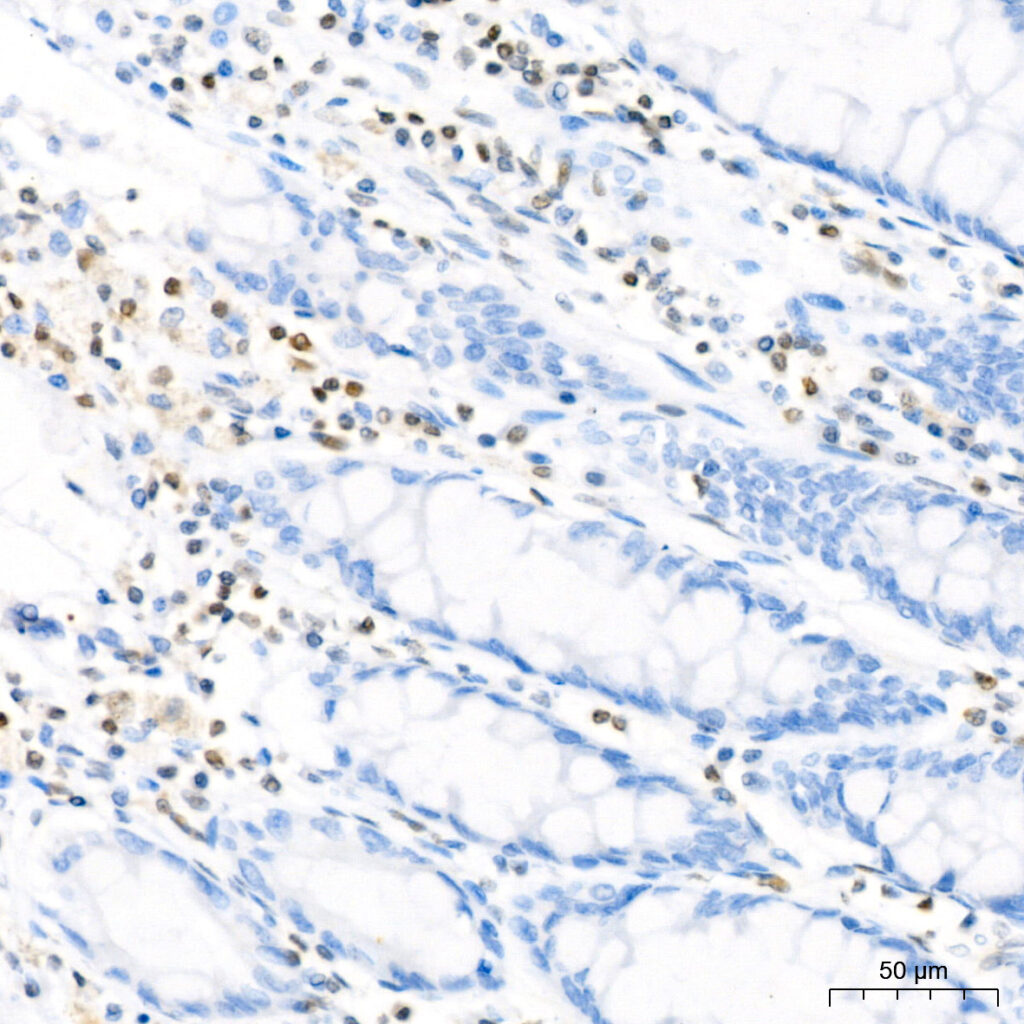
The antibody against IGF1 was raised in Rabbit using a synthetic peptide corresponding to a sequence within amino acids 70-150 of human IGF1 (P05019) as the immunogen. The monoclonal antibody exists as a isotype IgG, by affinity purification. This antibody has been validated on IHC-P, ELISA.
| Cat.No | ADA-15991A | Clonality | Monoclonal |
|---|---|---|---|
| Host Species | Rabbit | Target Name | IGF1 |
| Target Synonyms | IGF; MGF; IGFI; IGF-I; IGF1 | Form | Liquid |
| Species Reactivity | Human, Mouse | Isotype | IgG |
| Storage Buffer | 50% Glycerol, 0.05% BSA, PBS with 0.02% sodium azide, pH7.3. | Purification Method | Affinity purification |
| Application | ELISA, IHC-P |
| Immunogen Description | A synthetic peptide corresponding to a sequence within amino acids 70-150 of human IGF1 (P05019). | Target Species | Human |
|---|---|---|---|
| Immunogen Sequence | GFYFNKPTGYGSSSRRAPQTGIVDECCFRSCDLRRLEMYCAPLKPAKSARSVRAQRHTDMPKTQKYQPPSTNKNTKSQRRK | Uniprot ID | P05019 |
Uniprot Id
P05019
Target Species
Human
Target Name
IGF1
Target Full Name
Insulin-like growth factor 1
Target Function
The insulin-like growth factors, isolated from plasma, are structurally and functionally related to insulin but have a much higher growth-promoting activity. May be a physiological regulator of [1-14C]-2-deoxy-D-glucose (2DG) transport and glycogen synthesis in osteoblasts. Stimulates glucose transport in bone-derived osteoblastic (PyMS) cells and is effective at much lower concentrations than insulin, not only regarding glycogen and DNA synthesis but also with regard to enhancing glucose uptake. May play a role in synapse maturation. Ca(2+)-dependent exocytosis of IGF1 is required for sensory perception of smell in the olfactory bulb. Acts as a ligand for IGF1R. Binds to the alpha subunit of IGF1R, leading to the activation of the intrinsic tyrosine kinase activity which autophosphorylates tyrosine residues in the beta subunit thus initiatiating a cascade of down-stream signaling events leading to activation of the PI3K-AKT/PKB and the Ras-MAPK pathways. Binds to integrins ITGAV:ITGB3 and ITGA6:ITGB4. Its binding to integrins and subsequent ternary complex formation with integrins and IGFR1 are essential for IGF1 signaling. Induces the phosphorylation and activation of IGFR1, MAPK3/ERK1, MAPK1/ERK2 and AKT1.
Target Involvement
Insulin-like growth factor I deficiency (IGF1 deficiency)
Target Subcellular Location
Secreted.
Target Protein Families
Insulin family
Target Research Area
Signal Transduction
Target Synonyms
IBP1; IGF I; IGF IA; IGF IB; IGF-I; Igf1; IGF1_HUMAN; IGF1A; IGFI; IGFIA; Insulin like growth factor 1 (somatomedin C) ; Insulin like growth factor 1; Insulin like growth factor IA; Insulin like growth factor IB; Insulin-like growth factor I; Mechano growth factor; MGF; OTTHUMP00000195080; OTTHUMP00000195081; OTTHUMP00000195082; OTTHUMP00000195083; OTTHUMP00000195084; Somatomedia C; Somatomedin C; Somatomedin-C
Target Background
The protein encoded by this gene is similar to insulin in function and structure and is a member of a family of proteins involved in mediating growth and development. The encoded protein is processed from a precursor, bound by a specific receptor, and secreted. Defects in this gene are a cause of insulin-like growth factor I deficiency. Alternative splicing results in multiple transcript variants encoding different isoforms that may undergo similar processing to generate mature protein.
Notification