-
Chinese (Simplified)
-
English
-
German
-
Korean
-
Spanish
Chinese (Simplified)
English
German
Korean
Spanish
Sign up for an account to enjoy easy online shopping and instant order tracking.
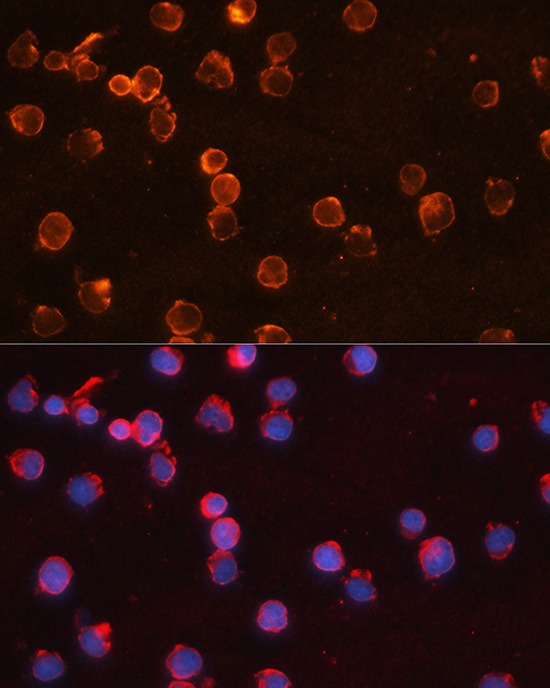
The antibody against IL10 was raised in Rabbit using a synthetic peptide corresponding to a sequence within amino acids 50-150 of human IL10 (NP_000563.1) as the immunogen. The polyclonal antibody exists as a isotype IgG, by affinity purification. This antibody has been validated on IF/ICC, ELISA.
| Cat.No | ADA-06942A | Clonality | Polyclonal |
|---|---|---|---|
| Host Species | Rabbit | Target Name | IL10 |
| Target Synonyms | CSIF; TGIF; GVHDS; IL-10; IL10A; IL10 | Form | Liquid |
| Species Reactivity | Human, Mouse, Rat | Isotype | IgG |
| Storage Buffer | 50% Glycerol, PBS with 0.01% thimerosal, pH7.3. | Purification Method | Affinity purification |
| Application | ELISA, IF/ICC |
| Immunogen Description | A synthetic peptide corresponding to a sequence within amino acids 50-150 of human IL10 (NP_000563.1). | Target Species | Human |
|---|---|---|---|
| Immunogen Sequence | RVKTFFQMKDQLDNLLLKESLLEDFKGYLGCQALSEMIQFYLEEVMPQAENQDPDIKAHVNSLGENLKTLRLRLRRCHRFLPCENKSKAVEQVKNAFNKLQ | Uniprot ID | P22301 |
Uniprot Id
P22301
Target Species
Human
Target Name
IL10
Target Full Name
Interleukin-10
Target Function
Major immune regulatory cytokine that acts on many cells of the immune system where it has profound anti-inflammatory functions, limiting excessive tissue disruption caused by inflammation. Mechanistically, IL10 binds to its heterotetrameric receptor comprising IL10RA and IL10RB leading to JAK1 and STAT2-mediated phosphorylation of STAT3. In turn, STAT3 translocates to the nucleus where it drives expression of anti-inflammatory mediators. Targets antigen-presenting cells (APCs) such as macrophages and monocytes and inhibits their release of pro-inflammatory cytokines including granulocyte-macrophage colony-stimulating factor /GM-CSF, granulocyte colony-stimulating factor/G-CSF, IL-1 alpha, IL-1 beta, IL-6, IL-8 and TNF-alpha. Interferes also with antigen presentation by reducing the expression of MHC-class II and co-stimulatory molecules, thereby inhibiting their ability to induce T cell activation. In addition, controls the inflammatory response of macrophages by reprogramming essential metabolic pathways including mTOR signaling.
Target Subcellular Location
Secreted.
Target Protein Families
IL-10 family
Target Tissue Specificity
Produced by a variety of cell lines, including T-cells, macrophages, mast cells and other cell types.
Target Research Area
Immunology
Target Synonyms
CSIF; Cytokine synthesis inhibitory factor; GVHDS; IL 10; IL-10; IL10; IL10_HUMAN; IL10A; Interleukin 10; Interleukin-10; MGC126450; MGC126451; T-cell growth inhibitory factor; TGIF
Target Background
The protein encoded by this gene is a cytokine produced primarily by monocytes and to a lesser extent by lymphocytes. This cytokine has pleiotropic effects in immunoregulation and inflammation. It down-regulates the expression of Th1 cytokines, MHC class II Ags, and costimulatory molecules on macrophages. It also enhances B cell survival, proliferation, and antibody production. This cytokine can block NF-kappa B activity, and is involved in the regulation of the JAK-STAT signaling pathway. Knockout studies in mice suggested the function of this cytokine as an essential immunoregulator in the intestinal tract. Mutations in this gene are associated with an increased susceptibility to HIV-1 infection and rheumatoid arthritis.
Notification