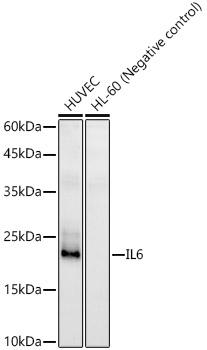
-
Chinese (Simplified)
-
English
-
German
-
Korean
-
Spanish
Chinese (Simplified)
English
German
Korean
Spanish
Sign up for an account to enjoy easy online shopping and instant order tracking.
The antibody against IL6 was raised in Rabbit using a synthetic peptide corresponding to a sequence within amino acids 30-212 of human IL6 (NP_000591.1) as the immunogen. The polyclonal antibody exists as a isotype IgG, by affinity purification. This antibody has been validated on WB, IF/ICC, ELISA.
| Cat.No | ADA-13151A | Clonality | Polyclonal |
|---|---|---|---|
| Host Species | Rabbit | Target Name | IL6 |
| Target Synonyms | CDF; HGF; HSF; BSF2; IL-6; BSF-2; IFNB2; IFN-beta-2; IL6 | Form | Liquid |
| Species Reactivity | Human, Mouse, Rat | Isotype | IgG |
| Storage Buffer | 50% Glycerol, PBS with 0.05% proclin300, pH7.3. | Purification Method | Affinity purification |
| Positive Samples | HUVEC | Application | ELISA, WB, IF/ICC |
| Immunogen Description | A synthetic peptide corresponding to a sequence within amino acids 30-212 of human IL6 (NP_000591.1). | Target Species | Human |
|---|---|---|---|
| Immunogen Sequence | VPPGEDSKDVAAPHRQPLTSSERIDKQIRYILDGISALRKETCNKSNMCESSKEALAENNLNLPKMAEKDGCFQSGFNEETCLVKIITGLLEFEVYLEYLQNRFESSEEQARAVQMSTKVLIQFLQKKAKNLDAITTPDPTTNASLLTKLQAQNQWLQDMTTHLILRSFKEFLQSSLRALRQM | Uniprot ID | P05231 |
Uniprot Id
P05231
Target Species
Human
Target Name
IL6
Target Full Name
Interleukin-6
Target Function
Cytokine with a wide variety of biological functions in immunity, tissue regeneration, and metabolism. Binds to IL6R, then the complex associates to the signaling subunit IL6ST/gp130 to trigger the intracellular IL6-signaling pathway (Probable). The interaction with the membrane-bound IL6R and IL6ST stimulates 'classic signaling', whereas the binding of IL6 and soluble IL6R to IL6ST stimulates 'trans-signaling'. Alternatively, 'cluster signaling' occurs when membrane-bound IL6:IL6R complexes on transmitter cells activate IL6ST receptors on neighboring receiver cells (Probable).; IL6 is a potent inducer of the acute phase response. Rapid production of IL6 contributes to host defense during infection and tissue injury, but excessive IL6 synthesis is involved in disease pathology. In the innate immune response, is synthesized by myeloid cells, such as macrophages and dendritic cells, upon recognition of pathogens through toll-like receptors (TLRs) at the site of infection or tissue injury (Probable). In the adaptive immune response, is required for the differentiation of B cells into immunoglobulin-secreting cells. Plays a major role in the differentiation of CD4(+) T cell subsets. Essential factor for the development of T follicular helper (Tfh) cells that are required for the induction of germinal-center formation. Required to drive naive CD4(+) T cells to the Th17 lineage. Also required for proliferation of myeloma cells and the survival of plasmablast cells.; Acts as an essential factor in bone homeostasis and on vessels directly or indirectly by induction of VEGF, resulting in increased angiogenesis activity and vascular permeability. Induces, through 'trans-signaling' and synergistically with IL1B and TNF, the production of VEGF. Involved in metabolic controls, is discharged into the bloodstream after muscle contraction increasing lipolysis and improving insulin resistance. 'Trans-signaling' in central nervous system also regulates energy and glucose homeostasis. Mediates, through GLP-1, crosstalk between insulin-sensitive tissues, intestinal L cells and pancreatic islets to adapt to changes in insulin demand. Also acts as a myokine (Probable). Plays a protective role during liver injury, being required for maintenance of tissue regeneration. Also has a pivotal role in iron metabolism by regulating HAMP/hepcidin expression upon inflammation or bacterial infection. Through activation of IL6ST-YAP-NOTCH pathway, induces inflammation-induced epithelial regeneration.
Target Involvement
Rheumatoid arthritis systemic juvenile (RASJ)
Target Subcellular Location
Secreted.
Target Protein Families
IL-6 superfamily
Target Tissue Specificity
Produced by skeletal muscle.
Target Research Area
Immunology
Target Synonyms
Interleukin BSF 2; B cell differentiation factor; B cell stimulatory factor 2; B-cell stimulatory factor 2; BSF 2; BSF-2; BSF2; CDF; CTL differentiation factor; Cytotoxic T cell differentiation factor; Hepatocyte stimulating factor; Hepatocyte stimulatory factor; HGF; HSF; Hybridoma growth factor; Hybridoma growth factor Interferon beta-2; Hybridoma plasmacytoma growth factor; IFN-beta-2; IFNB2; IL 6; IL-6; IL6; IL6_HUMAN; Interferon beta 2 ; Interferon beta-2; Interleukin 6 ; Interleukin 6 (interferon beta 2); Interleukin BSF 2; Interleukin-6
Target Background
This gene encodes a cytokine that functions in inflammation and the maturation of B cells. In addition, the encoded protein has been shown to be an endogenous pyrogen capable of inducing fever in people with autoimmune diseases or infections. The protein is primarily produced at sites of acute and chronic inflammation, where it is secreted into the serum and induces a transcriptional inflammatory response through interleukin 6 receptor, alpha. The functioning of this gene is implicated in a wide variety of inflammation-associated disease states, including suspectibility to diabetes mellitus and systemic juvenile rheumatoid arthritis. Elevated levels of the encoded protein have been found in virus infections, including COVID-19 (disease caused by SARS-CoV-2).
Notification