-
Chinese (Simplified)
-
English
-
German
-
Korean
-
Spanish
Chinese (Simplified)
English
German
Korean
Spanish
Sign up for an account to enjoy easy online shopping and instant order tracking.
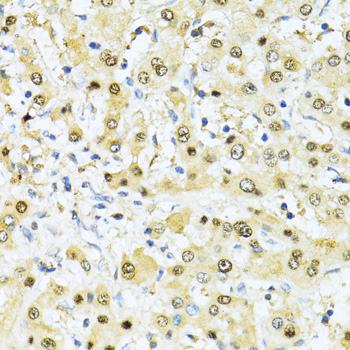
The antibody against ITGB3BP was raised in Rabbit using the recombinant fusion protein containing a sequence corresponding to amino acids 1-111 of human ITGB3BP (NP_055103.3) as the immunogen. The polyclonal antibody exists as a isotype IgG, by affinity purification. This antibody has been validated on IHC-P, ELISA.
| Cat.No | ADA-05412A | Clonality | Polyclonal |
|---|---|---|---|
| Host Species | Rabbit | Target Name | ITGB3BP |
| Target Synonyms | CENPR; NRIF3; TAP20; CENP-R; HSU37139; ITGB3BP | Form | Liquid |
| Species Reactivity | Human, Mouse, Rat | Isotype | IgG |
| Storage Buffer | 50% Glycerol, PBS with 0.01% thimerosal, pH7.3. | Purification Method | Affinity purification |
| Application | ELISA, IHC-P |
| Immunogen Description | Recombinant fusion protein containing a sequence corresponding to amino acids 1-111 of human ITGB3BP (NP_055103.3). | Target Species | Human |
|---|---|---|---|
| Immunogen Sequence | MPVKRSLKLDGLLEENSFDPSKITRKKSVITYSPTTGTCQMSLFASPTSSEEQKHRNGLSNEKRKKLNHPSLTESKESTTKDNDEFMMLLSKVEKLSEEIMEIMQNLSSIQ | Uniprot ID | Q13352 |
Uniprot Id
Q13352
Target Species
Human
Target Name
ITGB3BP
Target Full Name
Centromere protein R
Target Function
Transcription coregulator that can have both coactivator and corepressor functions. Isoform 1, but not other isoforms, is involved in the coactivation of nuclear receptors for retinoid X (RXRs) and thyroid hormone (TRs) in a ligand-dependent fashion. In contrast, it does not coactivate nuclear receptors for retinoic acid, vitamin D, progesterone receptor, nor glucocorticoid. Acts as a coactivator for estrogen receptor alpha. Acts as a transcriptional corepressor via its interaction with the NFKB1 NF-kappa-B subunit, possibly by interfering with the transactivation domain of NFKB1. Induces apoptosis in breast cancer cells, but not in other cancer cells, via a caspase-2 mediated pathway that involves mitochondrial membrane permeabilization but does not require other caspases. May also act as an inhibitor of cyclin A-associated kinase. Also acts a component of the CENPA-CAD (nucleosome distal) complex, a complex recruited to centromeres which is involved in assembly of kinetochore proteins, mitotic progression and chromosome segregation. May be involved in incorporation of newly synthesized CENPA into centromeres via its interaction with the CENPA-NAC complex.
Target Subcellular Location
[Isoform 1]: Nucleus. Chromosome, centromere. Chromosome, centromere, kinetochore.; [Isoform 2]: Nucleus.; [Isoform 3]: Nucleus. Cytoplasm. Note=Isoform 3 is predominantly nuclear and weakly cytoplasmic.; [Isoform 4]: Cytoplasm.
Target Tissue Specificity
Widely expressed. Expressed in spleen, thymus, prostate, ovary, small intestine and white blood cells. Highly expressed in testis and colon. Isoform 4 is expressed in platelets, lymphocytes and granulocytes.
Target Research Area
Epigenetics and Nuclear Signaling
Target Synonyms
ITGB3BP; CENPR; NRIF3Centromere protein R; CENP-R; Beta-3-endonexin; Integrin beta-3-binding protein; Nuclear receptor-interacting factor 3
Target Background
This gene encodes a transcriptional coregulator that binds to and enhances the activity of members of the nuclear receptor families, thyroid hormone receptors and retinoid X receptors. This protein also acts as a corepressor of NF-kappaB-dependent signaling. This protein induces apoptosis in breast cancer cells through a caspase 2-mediated signaling pathway. This protein is also a component of the centromere-specific histone H3 variant nucleosome associated complex (CENP-NAC) and may be involved in mitotic progression by recruiting the histone H3 variant CENP-A to the centromere. Alternate splicing results in multiple transcript variants.
Notification