• Contact info@abtriva.com for inquiries and orders.
  • Chinese (Simplified)

  • English

  • German

  • Korean

  • Spanish

United States (English / $ USD)

Rabbit anti-Human JMJD7 Polyclonal Antibody

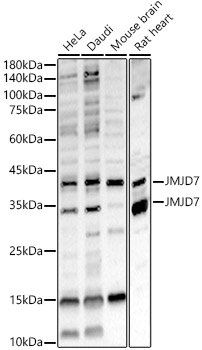
The antibody against JMJD7 was raised in Rabbit using the recombinant fusion protein containing a sequence corresponding to amino acids 1-316 of human JMJD7 (NP_001108104.1) as the immunogen. The polyclonal antibody exists as a isotype IgG, by affinity purification. This antibody has been validated on WB, ELISA.

ADA-02524A

The antibody against JMJD7 was raised in Rabbit using the recombinant fusion protein containing a sequence corresponding to amino acids 1-316 of human JMJD7 (NP_001108104.1) as the immunogen. The polyclonal antibody exists as a isotype IgG, by affinity purification. This antibody has been validated on WB, ELISA.

Number
Order Exclusive Products Now

Request a Quote
High Purity LevelsPrecision and ReliabilityCustomization Options

Specifications


Cat.No ADA-02524A ClonalityPolyclonal
Host SpeciesRabbitTarget NameJMJD7
Target SynonymsJMJD7FormLiquid
Species ReactivityHuman, Mouse, RatIsotypeIgG
Storage Buffer50% Glycerol, PBS with 0.02% sodium azide, pH7.3.Purification MethodAffinity purification
Positive SamplesHeLa, Rat heart, Daudi, Mouse brainApplicationELISA, WB

Immunogen Information


Immunogen DescriptionRecombinant fusion protein containing a sequence corresponding to amino acids 1-316 of human JMJD7 (NP_001108104.1).Target SpeciesHuman
Uniprot IDP0C870Immunogen Sequence
Background Information
  • Uniprot Id

    P0C870

  • Target Species

    Human

  • Target Name

    JMJD7

  • Target Full Name

    Bifunctional peptidase and (3S)-lysyl hydroxylase JMJD7

  • Target Function

    Bifunctional enzyme that acts both as an endopeptidase and 2-oxoglutarate-dependent monoxygenase. Endopeptidase that cleaves histones N-terminal tails at the carboxyl side of methylated arginine or lysine residues, to generate 'tailless nucleosomes', which may trigger transcription elongation. Preferentially recognizes and cleaves monomethylated and dimethylated arginine residues of histones H2, H3 and H4. After initial cleavage, continues to digest histones tails via its aminopeptidase activity. Additionally, may play a role in protein biosynthesis by modifying the translation machinery. Acts as Fe(2+) and 2-oxoglutarate-dependent monoxygenase, catalyzing (S)-stereospecific hydroxylation at C-3 of 'Lys-22' of DRG1 and 'Lys-21' of DRG2 translation factors (TRAFAC), promoting their interaction with ribonucleic acids (RNA).

  • Target Subcellular Location

    Nucleus. Cytoplasm.

  • Target Research Area

    Cell Biology

  • Target Synonyms

    JMJD7; Bifunctional peptidase and; 3S)-lysyl hydroxylase JMJD7; EC 1.14.11.63; EC 3.4.-.-; JmjC domain-containing protein 7; Jumonji domain-containing protein 7; L-lysine; 3S)-hydroxylase JMJD7

  • Target Background

    This gene encodes a highly conserved protein with a JmjC domain, which are part of the cupin metalloenzyme superfamily. JmjC proteins may function as 2-oxoglutarate-Fe(II)-dependent dioxygenases. Most tissues also express read-through transcripts from this gene into the downstream phospholipase A2, group IVB (cytosolic) gene, some of which may encode fusion proteins combining the N-terminus of this protein with the phospholipase A2, group IVB protein.

Inquire Rabbit anti-Human JMJD7 Polyclonal Antibody Now


AbTriva respects your privacy and protects your personal data in accordance with AbTriva. For more information, please see our data protection statement. *

Notification