• Contact info@abtriva.com for inquiries and orders.
  • Chinese (Simplified)

  • English

  • German

  • Korean

  • Spanish

United States (English / $ USD)

Rabbit anti-Human KATNA1 Polyclonal Antibody

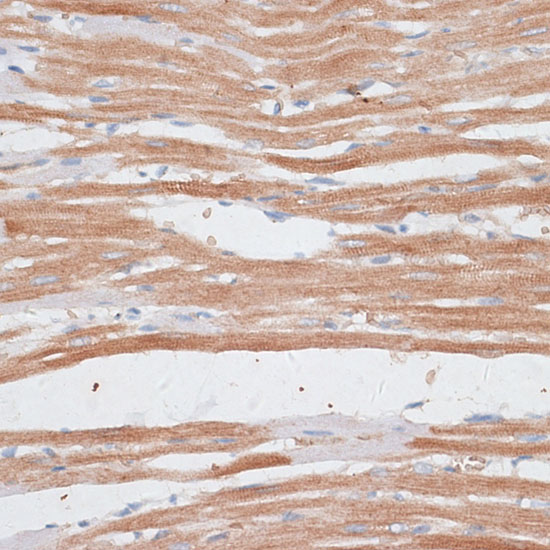
The antibody against KATNA1 was raised in Rabbit using the recombinant fusion protein containing a sequence corresponding to amino acids 1-167 of human KATNA1 (NP_001191005.1) as the immunogen. The polyclonal antibody exists as a isotype IgG, by affinity purification. This antibody has been validated on WB, IHC-P, ELISA.

ADA-00256A

The antibody against KATNA1 was raised in Rabbit using the recombinant fusion protein containing a sequence corresponding to amino acids 1-167 of human KATNA1 (NP_001191005.1) as the immunogen. The polyclonal antibody exists as a isotype IgG, by affinity purification. This antibody has been validated on WB, IHC-P, ELISA.

Number
Order Exclusive Products Now

Request a Quote
High Purity LevelsPrecision and ReliabilityCustomization Options

Specifications


Cat.No ADA-00256A ClonalityPolyclonal
Host SpeciesRabbitTarget NameKATNA1
Target SynonymsKATNA1FormLiquid
Species ReactivityHuman, Mouse, RatIsotypeIgG
Storage Buffer50% Glycerol, PBS with 0.01% thimerosal, pH7.3.Purification MethodAffinity purification
ApplicationELISA, WB, IHC-P

Immunogen Information


Immunogen DescriptionRecombinant fusion protein containing a sequence corresponding to amino acids 1-167 of human KATNA1 (NP_001191005.1).Target SpeciesHuman
Immunogen SequenceMSLLMISENVKLAREYALLGNYDSAMVYYQGVLDQMNKYLYSVKDTYLQQKWQQVWQEINVEAKHVKDIMKTLESFKLDSTPLKAAQHDLPASEGEVWSMPVPVERRPSPGPRKRQSSQYSDPKSHGNRPSTTVRVHRSSAQNVHNDRGKAVRCREKKEQNKGREEKUniprot IDO75449
Background Information
  • Uniprot Id

    O75449

  • Target Species

    Human

  • Target Name

    KATNA1

  • Target Full Name

    Katanin p60 ATPase-containing subunit A1

  • Target Function

    Catalytic subunit of a complex which severs microtubules in an ATP-dependent manner. Microtubule severing may promote rapid reorganization of cellular microtubule arrays and the release of microtubules from the centrosome following nucleation. Microtubule release from the mitotic spindle poles may allow depolymerization of the microtubule end proximal to the spindle pole, leading to poleward microtubule flux and poleward motion of chromosome. Microtubule release within the cell body of neurons may be required for their transport into neuronal processes by microtubule-dependent motor proteins. This transport is required for axonal growth.

  • Target Subcellular Location

    Cytoplasm. Midbody. Cytoplasm, cytoskeleton, microtubule organizing center, centrosome. Cytoplasm, cytoskeleton, spindle pole. Cytoplasm, cytoskeleton, spindle.

  • Target Protein Families

    AAA ATPase family, Katanin p60 subunit A1 subfamily

  • Target Research Area

    Cell Biology

  • Target Synonyms

    Katanin p60 ATPase containing subunit A1; Katanin p60 ATPase-containing subunit A1; Katanin p60 subunit A1; KATNA1; KTNA1_HUMAN; OTTHUMP00000017392; OTTHUMP00000042860; p60 katanin

  • Target Background

    Microtubules, polymers of alpha and beta tubulin subunits, form the mitotic spindle of a dividing cell and help to organize membranous organelles during interphase. Katanin is a heterodimer that consists of a 60 kDa ATPase (p60 subunit A 1) and an 80 kDa accessory protein (p80 subunit B 1). The p60 subunit acts to sever and disassemble microtubules, while the p80 subunit targets the enzyme to the centrosome. This gene encodes the p80 subunit. This protein is a member of the AAA family of ATPases. Multiple alternatively spliced variants, encoding the same protein, have been identified.

Inquire Rabbit anti-Human KATNA1 Polyclonal Antibody Now


AbTriva respects your privacy and protects your personal data in accordance with AbTriva. For more information, please see our data protection statement. *

Notification