-
Chinese (Simplified)
-
English
-
German
-
Korean
-
Spanish
Chinese (Simplified)
English
German
Korean
Spanish
Sign up for an account to enjoy easy online shopping and instant order tracking.
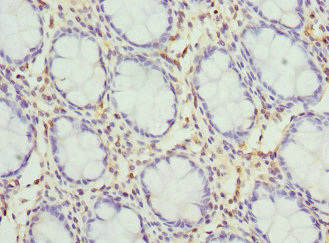
The antibody against KCNH1 was raised in rabbit using the Recombinant Human Potassium voltage-gated channel subfamily H member 1 protein (840-989AA) as the immunogen. This antibody exists as a non-conjugated isotype IgG, Antigen affinity purified. This antibody has been validated on ELISA, IHC.
$299.00
| Cat.No | ADC-17406A | Clonality | Polyclonal |
|---|---|---|---|
| Host Species | Rabbit | Target Name | KCNH1 |
| Target Synonyms | Drosophila, EAG antibody; EAG channel 1 antibody; EAG1 antibody; Ether a go go potassium channel 1 antibody; Ether a go go, homolog of antibody; Ether-a-go-go potassium channel 1 antibody; ether-a-go-go | Form | Liquid |
| Species Reactivity | Human | Isotype | IgG |
| Storage Buffer | 50% Glycerol, PBS with 0.02% sodium azide, pH7.3. | Purification Method | Antigen affinity purified |
| Conjugate | Non-conjugated | Application | ELISA, IHC |
| Storage | Upon receipt |
| Immunogen Description | Recombinant Human Potassium voltage-gated channel subfamily H member 1 protein (840-989AA) | Target Species | Human |
|---|---|---|---|
| Immunogen Sequence | Complete sequences for the immunogen, target protein, and peptides are available upon request. | Uniprot ID | O95259 |
Uniprot Id
O95259
Target Species
Human
Target Name
KCNH1
Target Full Name
Voltage-gated delayed rectifier potassium channel KCNH1
Target Function
Pore-forming (alpha) subunit of a voltage-gated delayed rectifier potassium channel. Channel properties are modulated by subunit assembly. Mediates IK(NI) current in myoblasts. Involved in the regulation of cell proliferation and differentiation, in particular adipogenic and osteogenic differentiation in bone marrow-derived mesenchymal stem cells (MSCs).
Target Involvement
Temple-Baraitser syndrome (TMBTS); Zimmermann-Laband syndrome 1 (ZLS1)
Target Subcellular Location
Cell membrane; Multi-pass membrane protein. Nucleus inner membrane; Multi-pass membrane protein. Cell projection, dendrite. Cell projection, axon. Cell junction, synapse, presynaptic cell membrane. Perikaryon. Cell junction, synapse, postsynaptic density membrane. Early endosome membrane. Note=Perinuclear KCNH1 is located to NPC-free islands.
Target Protein Families
Potassium channel family, H (Eag) (TC 1.A.1.20) subfamily, Kv10.1/KCNH1 sub-subfamily
Target Tissue Specificity
Highly expressed in brain and in myoblasts at the onset of fusion, but not in other tissues. Detected in HeLa (cervical carcinoma), SH-SY5Y (neuroblastoma) and MCF-7 (epithelial tumor) cells, but not in normal epithelial cells.
Target Synonyms
EAG; EAG channel 1; EAG1; Ether a go go potassium channel 1; Ether a go go, Drosophila, homolog of; Ether-a-go-go potassium channel 1; ether-a-go-go, Drosophila, homolog of; h eag; h-eag; hEAG1; Kcnh1; KCNH1_HUMAN; Kv10.1; M eag; MGC124419; MGC124420; MGC142269; Potassium voltage gated channel subfamily H (eag related), member 1; Potassium voltage gated channel subfamily H member 1; Potassium voltage-gated channel subfamily H member 1; Voltage gated potassium channel subunit Kv10.1; Voltage-gated potassium channel subunit Kv10.1
Target Background
Voltage-gated potassium (Kv) channels represent the most complex class of voltage-gated ion channels from both functional and structural standpoints. Their diverse functions include regulating neurotransmitter release, heart rate, insulin secretion, neuronal excitability, epithelial electrolyte transport, smooth muscle contraction, and cell volume. This gene encodes a member of the potassium channel, voltage-gated, subfamily H. This member is a pore-forming (alpha) subunit of a voltage-gated non-inactivating delayed rectifier potassium channel. It is activated at the onset of myoblast differentiation. The gene is highly expressed in brain and in myoblasts. Overexpression of the gene may confer a growth advantage to cancer cells and favor tumor cell proliferation. Alternative splicing of this gene results in two transcript variants encoding distinct isoforms.
Notification