-
Chinese (Simplified)
-
English
-
German
-
Korean
-
Spanish
Chinese (Simplified)
English
German
Korean
Spanish
Sign up for an account to enjoy easy online shopping and instant order tracking.
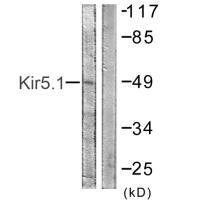
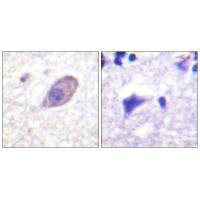
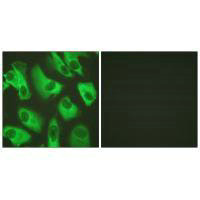
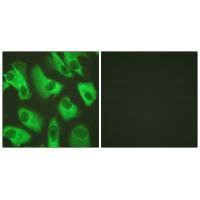
The antibody against KCNJ16 was raised in rabbit using the Synthesized non-phosphopeptide derived from Human Kir5. as the immunogen. The antibody was affinity-purified from rabbit antiserum by affinity-chromatography using epitope-specific immunogen. This antibody has been validated on ELISA, WB, IHC, IF.
$297.00
| Cat.No | ADC-42593A | Clonality | Polyclonal |
|---|---|---|---|
| Host Species | Rabbit | Target Name | KCNJ16 |
| Target Synonyms | inwardly rectifying subfamily J member 16, KCNJ16; Inward rectifier potassium channel 16; Inward rectifier K(+ channel Kir5.1; Potassium channel | Form | Liquid |
| Species Reactivity | Human, Mouse, Rat | Storage Buffer | PH 7.4, 0.02% sodium azide and 50% glycerol., 150mM NaCl, Rabbit IgG in phosphate buffered saline (without Mg2+ and Ca2+) |
| Purification Method | The antibody was affinity-purified from rabbit antiserum by affinity-chromatography using epitope-specific immunogen. | Application | ELISA, IF, IHC, WB |
| Storage | Upon receipt |
| Immunogen Description | Synthesized non-phosphopeptide derived from Human Kir5. | Target Species | Human |
|---|---|---|---|
| Immunogen Sequence | Complete sequences for the immunogen, target protein, and peptides are available upon request. | Uniprot ID | Q9NPI9 |
Uniprot Id
Q9NPI9
Target Species
Human
Target Name
KCNJ16
Target Full Name
Inward rectifier potassium channel 16
Target Function
Inward rectifier potassium channels are characterized by a greater tendency to allow potassium to flow into the cell rather than out of it. Their voltage dependence is regulated by the concentration of extracellular potassium; as external potassium is raised, the voltage range of the channel opening shifts to more positive voltages. The inward rectification is mainly due to the blockage of outward current by internal magnesium. KCNJ16 may be involved in the regulation of fluid and pH balance. In the kidney, together with KCNJ10, mediates basolateral K(+) recycling in distal tubules; this process is critical for Na(+) reabsorption at the tubules.
Target Subcellular Location
Membrane; Multi-pass membrane protein. Basolateral cell membrane.
Target Protein Families
Inward rectifier-type potassium channel (TC 1.A.2.1) family, KCNJ16 subfamily
Target Tissue Specificity
Widely expressed, with highest levels in adult and fetal kidney (at protein level). In the kidney, expressed in the proximal and distal convoluted tubules, but not in glomeruli nor collecting ducts.
Target Synonyms
KCNJ16; Inward rectifier potassium channel 16; Inward rectifier K(+ channel Kir5.1; Potassium channel, inwardly rectifying subfamily J member 16
Target Background
Potassium channels are present in most mammalian cells, where they participate in a wide range of physiologic responses. The protein encoded by this gene is an integral membrane protein and inward-rectifier type potassium channel. The encoded protein, which tends to allow potassium to flow into rather than out of a cell, can form heterodimers with two other inward-rectifier type potassium channels. It may function in fluid and pH balance regulation. Alternatively spliced transcript variants have been found for this gene.
Notification