• Contact info@abtriva.com for inquiries and orders.
  • Chinese (Simplified)

  • English

  • German

  • Korean

  • Spanish

United States (English / $ USD)

Rabbit anti-Human KCNJ2 Polyclonal Antibody

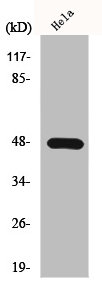
The antibody against KCNJ2 was raised in rabbit using the Synthesized peptide derived from the Internal region of Human KIR2.1. as the immunogen. This antibody exists as a non-conjugated isotype IgG. The antibody was affinity-purified from rabbit antiserum by affinity-chromatography using epitope-specific immunogen. This antibody has been validated on WB, IHC, ELISA.

ADC-38354A

The antibody against KCNJ2 was raised in rabbit using the Synthesized peptide derived from the Internal region of Human KIR2.1. as the immunogen. This antibody exists as a non-conjugated isotype IgG. The antibody was affinity-purified from rabbit antiserum by affinity-chromatography using epitope-specific immunogen. This antibody has been validated on WB, IHC, ELISA.

$167.00

Number
Order Exclusive Products Now

Request a Quote
High Purity LevelsPrecision and ReliabilityCustomization Options

Specifications


Cat.No ADC-38354A ClonalityPolyclonal
Host SpeciesRabbitTarget NameKCNJ2
Target Synonymsinwardly rectifying subfamily J member 2, KCNJ2; IRK1; Inward rectifier potassium channel 2; Cardiac inward rectifier potassium channel; Inward rectifier K(+ channel Kir2.1; IRK-1; hIRK1; Potassium channelFormLiquid
Species ReactivityHuman, RatIsotypeIgG
Storage Buffer0.5% BSA and 0.02% sodium azide., Liquid in PBS containing 50% glycerolPurification MethodThe antibody was affinity-purified from rabbit antiserum by affinity-chromatography using epitope-specific immunogen.
ConjugateNon-conjugatedApplicationELISA, IHC, WB
StorageUpon receipt

Immunogen Information


Immunogen DescriptionSynthesized peptide derived from the Internal region of Human KIR2.1.Target SpeciesHuman
Immunogen SequenceComplete sequences for the immunogen, target protein, and peptides are available upon request.Uniprot IDP63252
Background Information
  • Uniprot Id

    P63252

  • Target Species

    Human

  • Target Name

    KCNJ2

  • Target Full Name

    Inward rectifier potassium channel 2

  • Target Function

    Probably participates in establishing action potential waveform and excitability of neuronal and muscle tissues. Inward rectifier potassium channels are characterized by a greater tendency to allow potassium to flow into the cell rather than out of it. Their voltage dependence is regulated by the concentration of extracellular potassium; as external potassium is raised, the voltage range of the channel opening shifts to more positive voltages. The inward rectification is mainly due to the blockage of outward current by internal magnesium. Can be blocked by extracellular barium or cesium.

  • Target Involvement

    Long QT syndrome 7 (LQT7); Short QT syndrome 3 (SQT3); Atrial fibrillation, familial, 9 (ATFB9)

  • Target Subcellular Location

    Membrane; Multi-pass membrane protein. Membrane; Lipid-anchor.

  • Target Protein Families

    Inward rectifier-type potassium channel (TC 1.A.2.1) family, KCNJ2 subfamily

  • Target Tissue Specificity

    Heart, brain, placenta, lung, skeletal muscle, and kidney. Diffusely distributed throughout the brain.

  • Target Synonyms

    KCNJ2; IRK1; Inward rectifier potassium channel 2; Cardiac inward rectifier potassium channel; Inward rectifier K(+ channel Kir2.1; IRK-1; hIRK1; Potassium channel, inwardly rectifying subfamily J member 2

  • Target Background

    Potassium channels are present in most mammalian cells, where they participate in a wide range of physiologic responses. The protein encoded by this gene is an integral membrane protein and inward-rectifier type potassium channel. The encoded protein, which has a greater tendency to allow potassium to flow into a cell rather than out of a cell, probably participates in establishing action potential waveform and excitability of neuronal and muscle tissues. Mutations in this gene have been associated with Andersen syndrome, which is characterized by periodic paralysis, cardiac arrhythmias, and dysmorphic features.

Inquire Rabbit anti-Human KCNJ2 Polyclonal Antibody Now


AbTriva respects your privacy and protects your personal data in accordance with AbTriva. For more information, please see our data protection statement. *

Notification