• Contact info@abtriva.com for inquiries and orders.
  • Chinese (Simplified)

  • English

  • German

  • Korean

  • Spanish

United States (English / $ USD)

Rabbit anti-Human KCNJ9 Polyclonal Antibody

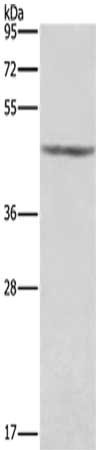
The antibody against KCNJ9 was raised in rabbit using the Synthetic peptide of Human KCNJ9 as the immunogen. This antibody exists as a non-conjugated isotype IgG, Antigen affinity purified. This antibody has been validated on ELISA, WB, IHC.

ADC-26672A

The antibody against KCNJ9 was raised in rabbit using the Synthetic peptide of Human KCNJ9 as the immunogen. This antibody exists as a non-conjugated isotype IgG, Antigen affinity purified. This antibody has been validated on ELISA, WB, IHC.

$299.00

Number
Order Exclusive Products Now

Request a Quote
High Purity LevelsPrecision and ReliabilityCustomization Options

Specifications


Cat.No ADC-26672A ClonalityPolyclonal
Host SpeciesRabbitTarget NameKCNJ9
Target Synonymsinwardly rectifying subfamily J member 9, KCNJ9; GIRK3; G protein-activated inward rectifier potassium channel 3; GIRK-3; Inward rectifier K(+ channel Kir3.3; Potassium channelFormLiquid
Species ReactivityHuman, Mouse, RatIsotypeIgG
Storage Buffer0.05% NaN3, 40% Glycerol., pH7.4 PBSPurification MethodAntigen affinity purified
ConjugateNon-conjugatedApplicationELISA, IHC, WB
StorageUpon receipt

Immunogen Information


Immunogen DescriptionSynthetic peptide of Human KCNJ9Target SpeciesHuman
Immunogen SequenceComplete sequences for the immunogen, target protein, and peptides are available upon request.Uniprot IDQ92806
Background Information
  • Uniprot Id

    Q92806

  • Target Species

    Human

  • Target Name

    KCNJ9

  • Target Full Name

    G protein-activated inward rectifier potassium channel 3

  • Target Function

    This receptor is controlled by G proteins. Inward rectifier potassium channels are characterized by a greater tendency to allow potassium to flow into the cell rather than out of it. Their voltage dependence is regulated by the concentration of extracellular potassium; as external potassium is raised, the voltage range of the channel opening shifts to more positive voltages. The inward rectification is mainly due to the blockage of outward current by internal magnesium.

  • Target Subcellular Location

    Membrane; Multi-pass membrane protein.

  • Target Protein Families

    Inward rectifier-type potassium channel (TC 1.A.2.1) family, KCNJ9 subfamily

  • Target Synonyms

    KCNJ9; GIRK3; G protein-activated inward rectifier potassium channel 3; GIRK-3; Inward rectifier K(+ channel Kir3.3; Potassium channel, inwardly rectifying subfamily J member 9

  • Target Background

    Potassium channels are present in most mammalian cells, where they participate in a wide range of physiologic responses. The protein encoded by this gene is an integral membrane protein and inward-rectifier type potassium channel. The encoded protein, which has a greater tendency to allow potassium to flow into a cell rather than out of a cell, is controlled by G-proteins. It associates with another G-protein-activated potassium channel to form a heteromultimeric pore-forming complex.

Inquire Rabbit anti-Human KCNJ9 Polyclonal Antibody Now


AbTriva respects your privacy and protects your personal data in accordance with AbTriva. For more information, please see our data protection statement. *

Notification