-
Chinese (Simplified)
-
English
-
German
-
Korean
-
Spanish
Chinese (Simplified)
English
German
Korean
Spanish
Sign up for an account to enjoy easy online shopping and instant order tracking.
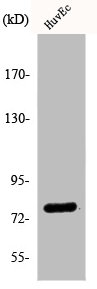
The antibody against KCNQ4 was raised in rabbit using the Synthesized peptide derived from the C-terminal region of Human KCNQ4. as the immunogen. This antibody exists as a non-conjugated isotype IgG. The antibody was affinity-purified from rabbit antiserum by affinity-chromatography using epitope-specific immunogen. This antibody has been validated on WB, ELISA.
$167.00
| Cat.No | ADC-38358A | Clonality | Polyclonal |
|---|---|---|---|
| Host Species | Rabbit | Target Name | KCNQ4 |
| Target Synonyms | KCNQ4; Potassium voltage-gated channel subfamily KQT member 4; KQT-like 4; Potassium channel subunit alpha KvLQT4; Voltage-gated potassium channel subunit Kv7.4 | Form | Liquid |
| Species Reactivity | Human, Mouse | Isotype | IgG |
| Storage Buffer | 0.5% BSA and 0.02% sodium azide., Liquid in PBS containing 50% glycerol | Purification Method | The antibody was affinity-purified from rabbit antiserum by affinity-chromatography using epitope-specific immunogen. |
| Conjugate | Non-conjugated | Application | ELISA, WB |
| Storage | Upon receipt |
| Immunogen Description | Synthesized peptide derived from the C-terminal region of Human KCNQ4. | Target Species | Human |
|---|---|---|---|
| Immunogen Sequence | Complete sequences for the immunogen, target protein, and peptides are available upon request. | Uniprot ID | P56696 |
Uniprot Id
P56696
Target Species
Human
Target Name
KCNQ4
Target Full Name
Potassium voltage-gated channel subfamily KQT member 4
Target Function
Probably important in the regulation of neuronal excitability. May underlie a potassium current involved in regulating the excitability of sensory cells of the cochlea. KCNQ4 channels are blocked by linopirdin, XE991 and bepridil, whereas clofilium is without significant effect. Muscarinic agonist oxotremorine-M strongly suppress KCNQ4 current in CHO cells in which cloned KCNQ4 channels were coexpressed with M1 muscarinic receptors.
Target Involvement
Deafness, autosomal dominant, 2A (DFNA2A)
Target Subcellular Location
Basal cell membrane; Multi-pass membrane protein.
Target Protein Families
Potassium channel family, KQT (TC 1.A.1.15) subfamily, Kv7.4/KCNQ4 sub-subfamily
Target Tissue Specificity
Expressed in the outer, but not the inner, sensory hair cells of the cochlea. Slightly expressed in heart, brain and skeletal muscle.
Target Synonyms
KCNQ4; Potassium voltage-gated channel subfamily KQT member 4; KQT-like 4; Potassium channel subunit alpha KvLQT4; Voltage-gated potassium channel subunit Kv7.4
Notification