-
Chinese (Simplified)
-
English
-
German
-
Korean
-
Spanish
Chinese (Simplified)
English
German
Korean
Spanish
Sign up for an account to enjoy easy online shopping and instant order tracking.
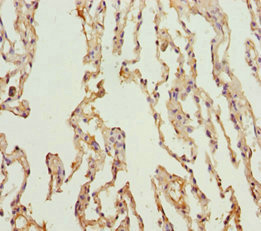
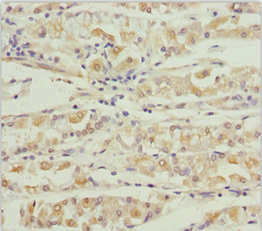
The antibody against KCNS3 was raised in rabbit using the Recombinant Human Potassium voltage-gated channel subfamily S member 3 protein (1-180AA) as the immunogen. This antibody exists as a non-conjugated isotype IgG, Antigen affinity purified. This antibody has been validated on ELISA, WB, IHC.
$299.00
| Cat.No | ADC-16787A | Clonality | Polyclonal |
|---|---|---|---|
| Host Species | Rabbit | Target Name | KCNS3 |
| Target Synonyms | KCNS3; Potassium voltage-gated channel subfamily S member 3; Delayed-rectifier K(+ channel alpha subunit 3; Voltage-gated potassium channel subunit Kv9.3 | Form | Liquid |
| Species Reactivity | Human, Mouse | Isotype | IgG |
| Storage Buffer | 50% Glycerol, PBS with 0.02% sodium azide, pH7.3. | Purification Method | Antigen affinity purified |
| Conjugate | Non-conjugated | Application | ELISA, IHC, WB |
| Storage | Upon receipt |
| Immunogen Description | Recombinant Human Potassium voltage-gated channel subfamily S member 3 protein (1-180AA) | Target Species | Human |
|---|---|---|---|
| Immunogen Sequence | Complete sequences for the immunogen, target protein, and peptides are available upon request. | Uniprot ID | Q9BQ31 |
Uniprot Id
Q9BQ31
Target Species
Human
Target Name
KCNS3
Target Full Name
Delayed-rectifier potassium channel regulatory subunit KCNS3
Target Function
Potassium channel subunit that does not form functional channels by itself. Can form functional heterotetrameric channels with KCNB1; modulates the delayed rectifier voltage-gated potassium channel activation and deactivation rates of KCNB1. Heterotetrameric channel activity formed with KCNB1 show increased current amplitude with the threshold for action potential activation shifted towards more negative values in hypoxic-treated pulmonary artery smooth muscle cells.
Target Subcellular Location
Cell membrane; Multi-pass membrane protein.
Target Protein Families
Potassium channel family, S (TC 1.A.1.2) subfamily, Kv9.3/KCNS3 sub-subfamily
Target Tissue Specificity
Detected in whole normal term placental and placental chorionic plate arteries and veins. Detected in syncytiotrophoblast and in blood vessel endothelium within intermediate villi and chorionic plate (at protein level). Detected in most tissues, but not i
Target Synonyms
KCNS3; Potassium voltage-gated channel subfamily S member 3; Delayed-rectifier K(+ channel alpha subunit 3; Voltage-gated potassium channel subunit Kv9.3
Target Background
Voltage-gated potassium channels form the largest and most diversified class of ion channels and are present in both excitable and nonexcitable cells. Their main functions are associated with the regulation of the resting membrane potential and the control of the shape and frequency of action potentials. The alpha subunits are of 2 types: those that are functional by themselves and those that are electrically silent but capable of modulating the activity of specific functional alpha subunits. The protein encoded by this gene is not functional by itself but can form heteromultimers with member 1 and with member 2 (and possibly other members) of the Shab-related subfamily of potassium voltage-gated channel proteins. This gene belongs to the S subfamily of the potassium channel family. Alternatively spliced transcript variants encoding the same protein have been found for this gene.
Notification