-
Chinese (Simplified)
-
English
-
German
-
Korean
-
Spanish

Chinese (Simplified)
English
German
Korean
Spanish
Sign up for an account to enjoy easy online shopping and instant order tracking.
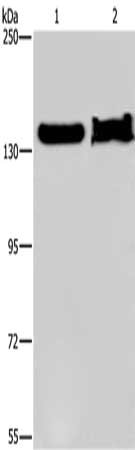
The antibody against KDM4A was raised in rabbit using the Synthetic peptide of Human KDM4A as the immunogen. This antibody exists as a non-conjugated isotype IgG, Antigen affinity purified. This antibody has been validated on ELISA, WB, IHC.
$299.00
| Cat.No | ADC-26509A | Clonality | Polyclonal |
|---|---|---|---|
| Host Species | Rabbit | Target Name | KDM4A |
| Form | Liquid | Species Reactivity | Human, Mouse |
| Isotype | IgG | Storage Buffer | 0.05% NaN3, 40% Glycerol., pH7.4 PBS |
| Purification Method | Antigen affinity purified | Conjugate | Non-conjugated |
| Application | ELISA, IHC, WB | Storage | Upon receipt |
| Immunogen Description | Synthetic peptide of Human KDM4A | Target Species | Human |
|---|---|---|---|
| Immunogen Sequence | Complete sequences for the immunogen, target protein, and peptides are available upon request. | Uniprot ID | O75164 |
Uniprot Id
O75164
Target Species
Human
Target Name
KDM4A
Target Full Name
Lysine-specific demethylase 4A
Target Function
Histone demethylase that specifically demethylates 'Lys-9' and 'Lys-36' residues of histone H3, thereby playing a central role in histone code. Does not demethylate histone H3 'Lys-4', H3 'Lys-27' nor H4 'Lys-20'. Demethylates trimethylated H3 'Lys-9' and H3 'Lys-36' residue, while it has no activity on mono- and dimethylated residues. Demethylation of Lys residue generates formaldehyde and succinate. Participates in transcriptional repression of ASCL2 and E2F-responsive promoters via the recruitment of histone deacetylases and NCOR1, respectively.; Crucial for muscle differentiation, promotes transcriptional activation of the Myog gene by directing the removal of repressive chromatin marks at its promoter. Lacks the N-terminal demethylase domain.
Target Subcellular Location
Nucleus.
Target Protein Families
JHDM3 histone demethylase family
Target Tissue Specificity
Ubiquitous.
Target Synonyms
JHDM3A; JmjC domain containing histone demethylation protein 3A; JmjC domain-containing histone demethylation protein 3A; JMJD2; JMJD2A; jumonji C domain containing histone demethylase 3A ; Jumonji domain containing 2; Jumonji domain containing 2A; Jumonji domain containing protein 2A; Jumonji domain-containing protein 2A; KDM4A; KDM4A_HUMAN; KIAA0677; Lysine (K) specific demethylase 4A; Lysine-specific demethylase 4A; TDRD14A; Tudor domain containing 14A
Target Background
This gene is a member of the Jumonji domain 2 (JMJD2) family and encodes a protein containing a JmjN domain, a JmjC domain, a JD2H domain, two TUDOR domains, and two PHD-type zinc fingers. This nuclear protein functions as a trimethylation-specific demethylase, converting specific trimethylated histone residues to the dimethylated form, and as a transcriptional repressor.
Notification