-
Chinese (Simplified)
-
English
-
German
-
Korean
-
Spanish
Chinese (Simplified)
English
German
Korean
Spanish
Sign up for an account to enjoy easy online shopping and instant order tracking.
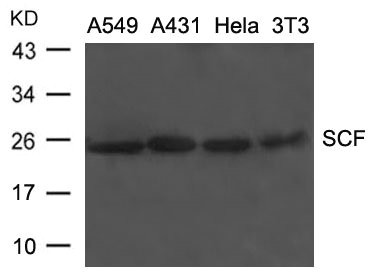
The antibody against KITLG was raised in rabbit using the Peptide sequence around aa.265~269(E-K-E-R-E) derived from Human SCF. as the immunogen. Antibodies were produced by immunizing rabbits with synthetic peptide and KLH conjugates. Antibodies were purified by affinity-chromatography using epitope-specific peptide. This antibody has been validated on ELISA, WB.
$297.00
| Cat.No | ADC-43142A | Clonality | Polyclonal |
|---|---|---|---|
| Host Species | Rabbit | Target Name | KITLG |
| Target Synonyms | homolog of antibody; Stem cell factor antibody; Stem cell factor precursor antibody, mouse | Form | Liquid |
| Species Reactivity | Human | Storage Buffer | PH 7.4, 0.02% sodium azide and 50% glycerol., 150mM NaCl, Supplied at 1.0mg/mL in phosphate buffered saline (without Mg2+ and Ca2+) |
| Purification Method | Antibodies were produced by immunizing rabbits with synthetic peptide and KLH conjugates. Antibodies were purified by affinity-chromatography using epitope-specific peptide. | Application | ELISA, WB |
| Storage | Upon receipt |
| Immunogen Description | Peptide sequence around aa.265~269(E-K-E-R-E) derived from Human SCF. | Target Species | Human |
|---|---|---|---|
| Immunogen Sequence | Complete sequences for the immunogen, target protein, and peptides are available upon request. | Uniprot ID | P21583 |
Uniprot Id
P21583
Target Species
Human
Target Name
KITLG
Target Full Name
Kit ligand
Target Function
Ligand for the receptor-type protein-tyrosine kinase KIT. Plays an essential role in the regulation of cell survival and proliferation, hematopoiesis, stem cell maintenance, gametogenesis, mast cell development, migration and function, and in melanogenesis. KITLG/SCF binding can activate several signaling pathways. Promotes phosphorylation of PIK3R1, the regulatory subunit of phosphatidylinositol 3-kinase, and subsequent activation of the kinase AKT1. KITLG/SCF and KIT also transmit signals via GRB2 and activation of RAS, RAF1 and the MAP kinases MAPK1/ERK2 and/or MAPK3/ERK1. KITLG/SCF and KIT promote activation of STAT family members STAT1, STAT3 and STAT5. KITLG/SCF and KIT promote activation of PLCG1, leading to the production of the cellular signaling molecules diacylglycerol and inositol 1,4,5-trisphosphate. KITLG/SCF acts synergistically with other cytokines, probably interleukins.
Target Involvement
Hyperpigmentation with or without hypopigmentation, familial progressive (FPHH); Deafness, congenital, unilateral or asymmetric (DCUA)
Target Subcellular Location
[Isoform 1]: Cell membrane; Single-pass type I membrane protein.; [Isoform 2]: Cytoplasm. Cytoplasm, cytoskeleton. Cell membrane; Single-pass type I membrane protein. Cell projection, lamellipodium. Cell projection, filopodium.; [Soluble KIT ligand]: Secreted.
Target Protein Families
SCF family
Target Research Area
Developmental Biology
Target Synonyms
C kit ligand; C-kit ligand; Ckit ligand; DCUA; DFNA69; DKFZp686F2250; familial progressive hyperpigmentation 2; FPH2; FPHH; KIT ligand; Kitl; KITLG; KL 1; KL1; Mast cell growth factor; MGF; MGF stem cell factor; SCF; SCF_HUMAN; SF; SHEP7; sKITLG; Soluble KIT ligand; Steel factor; steel, mouse, homolog of; Stem cell factor; Stem cell factor precursor
Target Background
This gene encodes the ligand of the tyrosine-kinase receptor encoded by the KIT locus. This ligand is a pleiotropic factor that acts in utero in germ cell and neural cell development, and hematopoiesis, all believed to reflect a role in cell migration. In adults, it functions pleiotropically, while mostly noted for its continued requirement in hematopoiesis. Two transcript variants encoding different isoforms have been found for this gene.
Notification