-
Chinese (Simplified)
-
English
-
German
-
Korean
-
Spanish
Chinese (Simplified)
English
German
Korean
Spanish
Sign up for an account to enjoy easy online shopping and instant order tracking.
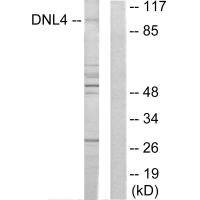
The antibody against LIG4 was raised in rabbit using the Synthesized peptide derived from internal of Human DNL4. as the immunogen. The antibody was affinity-purified from rabbit antiserum by affinity-chromatography using epitope-specific immunogen. This antibody has been validated on ELISA, WB.
$297.00
| Cat.No | ADC-41622A | Clonality | Polyclonal |
|---|---|---|---|
| Host Species | Rabbit | Target Name | LIG4 |
| Form | Liquid | Species Reactivity | Human |
| Storage Buffer | PH 7.4, 0.02% sodium azide and 50% glycerol., 150mM NaCl, Rabbit IgG in phosphate buffered saline (without Mg2+ and Ca2+) | Purification Method | The antibody was affinity-purified from rabbit antiserum by affinity-chromatography using epitope-specific immunogen. |
| Application | ELISA, WB | Storage | Upon receipt |
| Immunogen Description | Synthesized peptide derived from internal of Human DNL4. | Target Species | Human |
|---|---|---|---|
| Immunogen Sequence | Complete sequences for the immunogen, target protein, and peptides are available upon request. | Uniprot ID | P49917 |
Uniprot Id
P49917
Target Species
Human
Target Name
LIG4
Target Full Name
DNA ligase 4
Target Function
DNA ligase involved in DNA non-homologous end joining (NHEJ); required for double-strand break (DSB) repair and V(D)J recombination. Catalyzes the NHEJ ligation step of the broken DNA during DSB repair by resealing the DNA breaks after the gap filling is completed. Joins single-strand breaks in a double-stranded polydeoxynucleotide in an ATP-dependent reaction. LIG4 is mechanistically flexible: it can ligate nicks as well as compatible DNA overhangs alone, while in the presence of XRCC4, it can ligate ends with 2-nucleotides (nt) microhomology and 1-nt gaps. Forms a subcomplex with XRCC4; the LIG4-XRCC4 subcomplex is responsible for the NHEJ ligation step and XRCC4 enhances the joining activity of LIG4. Binding of the LIG4-XRCC4 complex to DNA ends is dependent on the assembly of the DNA-dependent protein kinase complex DNA-PK to these DNA ends. LIG4 regulates nuclear localization of XRCC4.
Target Involvement
LIG4 syndrome (LIG4S); Severe combined immunodeficiency autosomal recessive T-cell-negative/B-cell-negative/NK-cell-positive with sensitivity to ionizing radiation (RSSCID)
Target Subcellular Location
Nucleus.
Target Protein Families
ATP-dependent DNA ligase family
Target Tissue Specificity
Testis, thymus, prostate and heart.
Target Synonyms
DNA ligase IV ATP dependent; DNA joinase; DNA ligase 4; DNA ligase IV; DNA repair enzyme; DNLI4_HUMAN; LIG 4; LIG4; LIG4S; Ligase IV; Ligase IV DNA ATP dependent; Polydeoxyribonucleotide synthase [ATP] 4; Polydeoxyribonucleotide synthase 4; Polydeoxyribonucleotide synthase; Polynucleotide ligase; Sealase
Target Background
The protein encoded by this gene is a DNA ligase that joins single-strand breaks in a double-stranded polydeoxynucleotide in an ATP-dependent reaction. This protein is essential for V(D)J recombination and DNA double-strand break (DSB) repair through nonhomologous end joining (NHEJ). This protein forms a complex with the X-ray repair cross complementing protein 4 (XRCC4), and further interacts with the DNA-dependent protein kinase (DNA-PK). Both XRCC4 and DNA-PK are known to be required for NHEJ. The crystal structure of the complex formed by this protein and XRCC4 has been resolved. Defects in this gene are the cause of LIG4 syndrome. Alternatively spliced transcript variants encoding the same protein have been observed.
Notification