-
Chinese (Simplified)
-
English
-
German
-
Korean
-
Spanish
Chinese (Simplified)
English
German
Korean
Spanish
Sign up for an account to enjoy easy online shopping and instant order tracking.
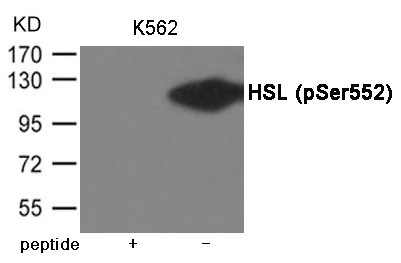
The antibody against LIPE was raised in rabbit using the Peptide sequence around phosphorylation site of serine 552(V-L-S(p)-S-L) derived from Human HSL. as the immunogen. Antibodies were produced by immunizing rabbits with synthetic phosphopeptide and KLH conjugates. Antibodies were purified by affinity-chromatography using epitope-specific phosphopeptide. Non-phospho specific antibodies were removed by chromatogramphy usi This antibody has been validated on ELISA, WB.
$360.00
| Cat.No | ADC-43008A | Clonality | Polyclonal |
|---|---|---|---|
| Host Species | Rabbit | Target Name | LIPE |
| Form | Liquid | Species Reactivity | Human, Mouse, Rat |
| Storage Buffer | PH 7.4, 0.02% sodium azide and 50% glycerol., 150mM NaCl, Supplied at 1.0mg/mL in phosphate buffered saline (without Mg2+ and Ca2+) | Application | ELISA, WB |
| Storage | Upon receipt |
| Immunogen Description | Peptide sequence around phosphorylation site of serine 552(V-L-S(p)-S-L) derived from Human HSL. | Target Species | Human |
|---|---|---|---|
| Immunogen Sequence | Complete sequences for the immunogen, target protein, and peptides are available upon request. | Uniprot ID | Q05469 |
Uniprot Id
Q05469
Target Species
Human
Target Name
LIPE
Target Full Name
Hormone-sensitive lipase
Target Function
Lipase with broad substrate specificity, catalyzing the hydrolysis of triacylglycerols (TAGs), diacylglycerols (DAGs), monoacylglycerols (MAGs), cholesteryl esters and retinyl esters. Shows a preferential hydrolysis of DAGs over TAGs and MAGs and preferentially hydrolyzes the fatty acid (FA) esters at the sn-3 position of the glycerol backbone in DAGs. Preferentially hydrolyzes FA esters at the sn-1 and sn-2 positions of the glycerol backbone in TAGs. Catalyzes the hydrolysis of 2-arachidonoylglycerol, an endocannabinoid and of 2-acetyl monoalkylglycerol ether, the penultimate precursor of the pathway for de novo synthesis of platelet-activating factor. In adipose tissue and heart, it primarily hydrolyzes stored triglycerides to free fatty acids, while in steroidogenic tissues, it principally converts cholesteryl esters to free cholesterol for steroid hormone production.
Target Involvement
Lipodystrophy, familial partial, 6 (FPLD6)
Target Subcellular Location
Cell membrane. Membrane, caveola. Cytoplasm, cytosol. Lipid droplet.
Target Protein Families
'GDXG' lipolytic enzyme family
Target Tissue Specificity
Testis.
Target Synonyms
Hormone sensitive lipase; Hormone sensitive lipase testicular isoform; Hormone-sensitive lipase; HSL; LHS; Lipase hormone sensitive ; LIPE; LIPS_HUMAN
Target Background
The protein encoded by this gene has a long and a short form, generated by use of alternative translational start codons. The long form is expressed in steroidogenic tissues such as testis, where it converts cholesteryl esters to free cholesterol for steroid hormone production. The short form is expressed in adipose tissue, among others, where it hydrolyzes stored triglycerides to free fatty acids.
Notification