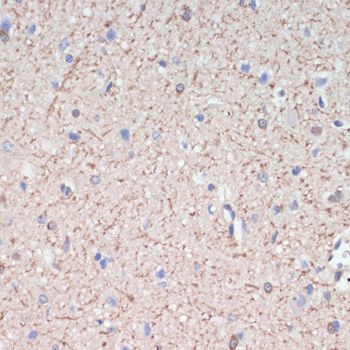
-
Chinese (Simplified)
-
English
-
German
-
Korean
-
Spanish
Chinese (Simplified)
English
German
Korean
Spanish
Sign up for an account to enjoy easy online shopping and instant order tracking.
The antibody against MAG was raised in Rabbit using the recombinant fusion protein containing a sequence corresponding to amino acids 20-220 of human MAG (P20916) as the immunogen. The polyclonal antibody exists as a isotype IgG, by affinity purification. This antibody has been validated on WB, IHC-P, ELISA.
| Cat.No | ADA-09788A | Clonality | Polyclonal |
|---|---|---|---|
| Host Species | Rabbit | Target Name | MAG |
| Target Synonyms | GMA; S-MAG; SPG75; SIGLEC4A; SIGLEC-4A; MAG | Form | Liquid |
| Species Reactivity | Human, Mouse, Rat | Isotype | IgG |
| Storage Buffer | 50% Glycerol, PBS with 0.02% sodium azide, pH7.3. | Purification Method | Affinity purification |
| Application | ELISA, WB, IHC-P |
| Immunogen Description | Recombinant fusion protein containing a sequence corresponding to amino acids 20-220 of human MAG (P20916). | Target Species | Human |
|---|---|---|---|
| Uniprot ID | P20916 | Immunogen Sequence |
Uniprot Id
P20916
Target Species
Human
Target Name
MAG
Target Full Name
Myelin-associated glycoprotein
Target Function
Adhesion molecule that mediates interactions between myelinating cells and neurons by binding to neuronal sialic acid-containing gangliosides and to the glycoproteins RTN4R and RTN4RL2. Not required for initial myelination, but seems to play a role in the maintenance of normal axon myelination. Protects motoneurons against apoptosis, also after injury; protection against apoptosis is probably mediated via interaction with neuronal RTN4R and RTN4RL2. Required to prevent degeneration of myelinated axons in adults; this probably depends on binding to gangliosides on the axon cell membrane. Negative regulator of neurite outgrowth; in dorsal root ganglion neurons the inhibition is mediated primarily via binding to neuronal RTN4R or RTN4RL2 and to a lesser degree via binding to neuronal gangliosides. In cerebellar granule cells the inhibition is mediated primarily via binding to neuronal gangliosides. In sensory neurons, inhibition of neurite extension depends only partially on RTN4R, RTN4RL2 and gangliosides. Inhibits axon longitudinal growth. Inhibits axon outgrowth by binding to RTN4R. Preferentially binds to alpha-2,3-linked sialic acid. Binds ganglioside Gt1b.
Target Involvement
Spastic paraplegia 75, autosomal recessive (SPG75)
Target Subcellular Location
Cell membrane; Single-pass type I membrane protein. Membrane raft.
Target Protein Families
Immunoglobulin superfamily, SIGLEC (sialic acid binding Ig-like lectin) family
Target Tissue Specificity
Both isoform 1 and isoform 2 are detected in myelinated structures in the central and peripheral nervous system, in periaxonal myelin and at Schmidt-Lanterman incisures. Detected in optic nerve, in oligodendroglia and in periaxonal myelin sheaths. Detecte
Target Research Area
Cell Adhesion
Target Synonyms
GMA; MAG; MAG_HUMAN; Myelin associated glycoprotein; Myelin-associated glycoprotein; S MAG; S-MAG; Sialic acid binding Ig like lectin 4A; Sialic acid binding immunoglobulin like lectin 4A; Siglec 4a; Siglec-4a; SIGLEC4A; SPG75
Target Background
The protein encoded by this gene is a type I membrane protein and member of the immunoglobulin superfamily. It is thought to be involved in the process of myelination. It is a lectin that binds to sialylated glycoconjugates and mediates certain myelin-neuron cell-cell interactions. Three alternatively spliced transcripts encoding different isoforms have been described for this gene.
Notification