-
Chinese (Simplified)
-
English
-
German
-
Korean
-
Spanish
Chinese (Simplified)
English
German
Korean
Spanish
Sign up for an account to enjoy easy online shopping and instant order tracking.
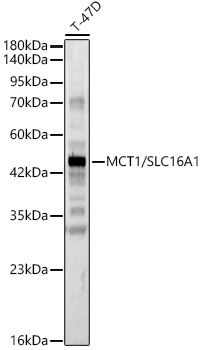
The antibody against MCT1/SLC16A1 was raised in Rabbit using the recombinant fusion protein containing a sequence corresponding to amino acids 190-245 of human MCT1 (NP_003042.3) as the immunogen. The polyclonal antibody exists as a isotype IgG, by affinity purification. This antibody has been validated on WB, IF/ICC, ELISA.
| Cat.No | ADA-12501A | Clonality | Polyclonal |
|---|---|---|---|
| Host Species | Rabbit | Target Name | MCT1/SLC16A1 |
| Target Synonyms | MCT; HHF7; MCT1; MCT1D; MCT1/SLC16A1 | Form | Liquid |
| Species Reactivity | Human, Mouse, Rat | Isotype | IgG |
| Storage Buffer | 50% Glycerol, PBS with 0.05% proclin300, pH7.3. | Purification Method | Affinity purification |
| Positive Samples | T-47D | Application | ELISA, WB, IF/ICC |
| Immunogen Description | Recombinant fusion protein containing a sequence corresponding to amino acids 190-245 of human MCT1 (NP_003042.3). | Target Species | Human |
|---|---|---|---|
| Immunogen Sequence | VAGALMRPIGPKPTKAGKDKSKASLEKAGKSGVKKDLHDANTDLIGRHPKQEKRSV | Uniprot ID | P53985 |
Uniprot Id
P53985
Target Species
Human
Target Name
SLC16A1
Target Full Name
Monocarboxylate transporter 1
Target Function
Proton-coupled monocarboxylate transporter. Catalyzes the rapid transport across the plasma membrane of many monocarboxylates such as lactate, pyruvate, branched-chain oxo acids derived from leucine, valine and isoleucine, and the ketone bodies acetoacetate, beta-hydroxybutyrate and acetate. Depending on the tissue and on cicumstances, mediates the import or export of lactic acid and ketone bodies. Required for normal nutrient assimilation, increase of white adipose tissue and body weight gain when on a high-fat diet. Plays a role in cellular responses to a high-fat diet by modulating the cellular levels of lactate and pyruvate, small molecules that contribute to the regulation of central metabolic pathways and insulin secretion, with concomitant effects on plasma insulin levels and blood glucose homeostasis.
Target Involvement
Symptomatic deficiency in lactate transport (SDLT); Familial hyperinsulinemic hypoglycemia 7 (HHF7); Monocarboxylate transporter 1 deficiency (MCT1D)
Target Subcellular Location
Cell membrane; Multi-pass membrane protein.
Target Protein Families
Major facilitator superfamily, Monocarboxylate porter (TC 2.A.1.13) family
Target Tissue Specificity
Detected in heart and in blood lymphocytes and monocytes (at protein level). Widely expressed.
Target Synonyms
FLJ36745; HHF7; MCT 1; MCT; MGC44475; Monocarboxylate transporter 1; Monocarboxylate transporter; Monocarboxylate transporter isoform 1; Monocarboxylic acid transporter 1; MOT1_HUMAN; Slc16a1; SLC16A1 protein; Solute carrier family 16 (monocarboxylic acid transporters) member 1; Solute carrier family 16 member 1 (monocarboxylic acid transporter 1); Solute carrier family 16 member 1
Target Background
The protein encoded by this gene is a proton-linked monocarboxylate transporter that catalyzes the movement of many monocarboxylates, such as lactate and pyruvate, across the plasma membrane. Mutations in this gene are associated with erythrocyte lactate transporter defect. Alternatively spliced transcript variants have been found for this gene.
Notification