-
Chinese (Simplified)
-
English
-
German
-
Korean
-
Spanish
Chinese (Simplified)
English
German
Korean
Spanish
Sign up for an account to enjoy easy online shopping and instant order tracking.
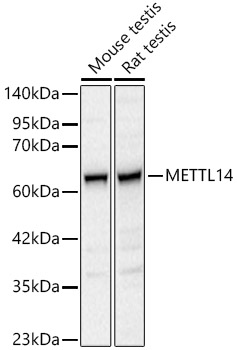
The antibody against METTL14 was raised in Rabbit using the recombinant fusion protein containing a sequence corresponding to amino acids 1-210 of human METTL14 (NP_066012.1) as the immunogen. The polyclonal antibody exists as a isotype IgG, by affinity purification. This antibody has been validated on WB, IHC-P, ELISA.
| Cat.No | ADA-13067A | Clonality | Polyclonal |
|---|---|---|---|
| Host Species | Rabbit | Target Name | METTL14 |
| Target Synonyms | hMETTL14; METTL14 | Form | Liquid |
| Species Reactivity | Human, Mouse, Rat | Isotype | IgG |
| Storage Buffer | 50% Glycerol, PBS with 0.05% proclin300, pH7.3. | Purification Method | Affinity purification |
| Positive Samples | Mouse testis, Rat testis | Application | ELISA, WB, IHC-P |
| Immunogen Description | Recombinant fusion protein containing a sequence corresponding to amino acids 1-210 of human METTL14 (NP_066012.1). | Target Species | Human |
|---|---|---|---|
| Uniprot ID | Q9HCE5 | Immunogen Sequence |
Uniprot Id
Q9HCE5
Target Species
Human
Target Name
METTL14
Target Full Name
N(6)-adenosine-methyltransferase non-catalytic subunit METTL14
Target Function
The METTL3-METTL14 heterodimer forms a N6-methyltransferase complex that methylates adenosine residues at the N(6) position of some mRNAs and regulates the circadian clock, differentiation of embryonic stem cells and cortical neurogenesis. In the heterodimer formed with METTL3, METTL14 constitutes the RNA-binding scaffold that recognizes the substrate rather than the catalytic core. N6-methyladenosine (m6A), which takes place at the 5'-[AG]GAC-3' consensus sites of some mRNAs, plays a role in mRNA stability and processing. M6A acts as a key regulator of mRNA stability by promoting mRNA destabilization and degradation. In embryonic stem cells (ESCs), m6A methylation of mRNAs encoding key naive pluripotency-promoting transcripts results in transcript destabilization. M6A regulates spermatogonial differentiation and meiosis and is essential for male fertility and spermatogenesis. M6A also regulates cortical neurogenesis: m6A methylation of transcripts related to transcription factors, neural stem cells, the cell cycle and neuronal differentiation during brain development promotes their destabilization and decay, promoting differentiation of radial glial cells.
Target Subcellular Location
Nucleus.
Target Protein Families
MT-A70-like family
Target Research Area
Cell Biology
Target Synonyms
KIAA1627; MET14_HUMAN; Methyltransferase like 14; Methyltransferase-like protein 14; METTL14; N6-adenosine-methyltransferase subunit METTL14; OTTHUMP00000219837
Target Background
Enables mRNA binding activity. Contributes to mRNA (2'-O-methyladenosine-N6-)-methyltransferase activity. Involved in mRNA metabolic process; negative regulation of hematopoietic progenitor cell differentiation; and positive regulation of translation. Located in nucleoplasm. Part of RNA N6-methyladenosine methyltransferase complex.
Notification