• Contact info@abtriva.com for inquiries and orders.
  • Chinese (Simplified)

  • English

  • German

  • Korean

  • Spanish

United States (English / $ USD)

Rabbit anti-Human MKL1 Polyclonal Antibody

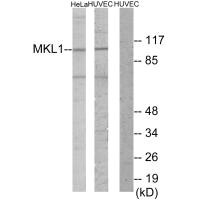
The antibody against MKL1 was raised in rabbit using the Synthesized peptide derived from N-terminal of Human MKL1. as the immunogen. The antibody was affinity-purified from rabbit antiserum by affinity-chromatography using epitope-specific immunogen. This antibody has been validated on ELISA, WB.

ADC-41846A

The antibody against MKL1 was raised in rabbit using the Synthesized peptide derived from N-terminal of Human MKL1. as the immunogen. The antibody was affinity-purified from rabbit antiserum by affinity-chromatography using epitope-specific immunogen. This antibody has been validated on ELISA, WB.

$297.00

Number
Order Exclusive Products Now

Request a Quote
High Purity LevelsPrecision and ReliabilityCustomization Options

Specifications


Cat.No ADC-41846A ClonalityPolyclonal
Host SpeciesRabbitTarget NameMKL1
FormLiquidSpecies ReactivityHuman, Mouse
Storage BufferPH 7.4, 0.02% sodium azide and 50% glycerol., 150mM NaCl, Rabbit IgG in phosphate buffered saline (without Mg2+ and Ca2+)Purification MethodThe antibody was affinity-purified from rabbit antiserum by affinity-chromatography using epitope-specific immunogen.
ApplicationELISA, WBStorageUpon receipt

Immunogen Information


Immunogen DescriptionSynthesized peptide derived from N-terminal of Human MKL1.Target SpeciesHuman
Immunogen SequenceComplete sequences for the immunogen, target protein, and peptides are available upon request.Uniprot IDQ969V6
Background Information
  • Uniprot Id

    Q969V6

  • Target Species

    Human

  • Target Name

    MRTFA

  • Target Full Name

    Myocardin-related transcription factor A

  • Target Function

    Transcription coactivator that associates with the serum response factor (SRF) transcription factor to control expression of genes regulating the cytoskeleton during development, morphogenesis and cell migration. The SRF-MRTFA complex activity responds to Rho GTPase-induced changes in cellular globular actin (G-actin) concentration, thereby coupling cytoskeletal gene expression to cytoskeletal dynamics. MRTFA binds G-actin via its RPEL repeats, regulating activity of the MRTFA-SRF complex. Activity is also regulated by filamentous actin (F-actin) in the nucleus.

  • Target Involvement

    A chromosomal aberration involving MKL1 may be a cause of acute megakaryoblastic leukemia. Translocation t(1;22)(p13;q13) with RBM15. Although both reciprocal fusion transcripts are detected in acute megakaryoblastic leukemia (AMKL, FAB-M7), the RBM15-MKL1 chimeric protein has all the putative functional domains encoded by each gene and is the candidate oncogene.

  • Target Subcellular Location

    Cytoplasm. Nucleus.

  • Target Tissue Specificity

    Ubiquitously expressed, has been detected in lung, placenta, small intestine, liver, kidney, spleen, thymus, colon, muscle, heart and brain. Expressed in peripheral blood mononuclear cells (at protein level).

  • Target Research Area

    Others

  • Target Synonyms

    AI852829; AMKL; AW743281; AW821984; Basic SAP coiled-coil transcription activator; Bsac; KIAA1438; Mal; Megakaryoblastic leukemia 1 protein; Megakaryocytic acute leukemia protein; MKL (megakaryoblastic leukemia)/myocardin like 1; MKL/myocardin like protein 1; MKL/myocardin-like protein 1; Mkl1; MKL1_HUMAN; MRTF A; Mrtf A; MRTF-A; MRTFA; MYOCARDIN RELATED PROTEIN; Myocardin related transcription factor A; Myocardin-related transcription factor A

  • Target Background

    The protein encoded by this gene interacts with the transcription factor myocardin, a key regulator of smooth muscle cell differentiation. The encoded protein is predominantly nuclear and may help transduce signals from the cytoskeleton to the nucleus. This gene is involved in a specific translocation event that creates a fusion of this gene and the RNA-binding motif protein-15 gene. This translocation has been associated with acute megakaryocytic leukemia. Alternative splicing results in multiple transcript variants.

Inquire Rabbit anti-Human MKL1 Polyclonal Antibody Now


AbTriva respects your privacy and protects your personal data in accordance with AbTriva. For more information, please see our data protection statement. *

Notification