-
Chinese (Simplified)
-
English
-
German
-
Korean
-
Spanish
Chinese (Simplified)
English
German
Korean
Spanish
Sign up for an account to enjoy easy online shopping and instant order tracking.
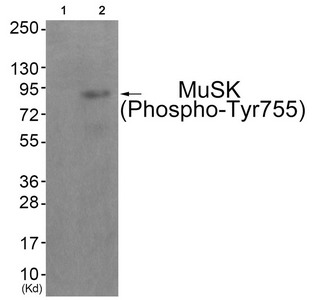
The antibody against MUSK was raised in rabbit using the Peptide sequence around phosphorylation site of tyrosine 755(A-D-Y(p)-Y-K) derived from Human MuSK . as the immunogen. Antibodies were produced by immunizing rabbits with synthetic phosphopeptide and KLH conjugates. Antibodies were purified by affinity-chromatography using epitope-specific phosphopeptide. Non-phospho specific antibodies were removed by chromatogramphy usi This antibody has been validated on ELISA, WB.
$360.00
| Cat.No | ADC-42322A | Clonality | Polyclonal |
|---|---|---|---|
| Host Species | Rabbit | Target Name | MUSK |
| Target Synonyms | MUSK; Muscle, skeletal receptor tyrosine-protein kinase; Muscle-specific tyrosine-protein kinase receptor; MuSK; Muscle-specific kinase receptor | Form | Liquid |
| Species Reactivity | Human, Mouse, Rat | Storage Buffer | PH 7.4, 0.02% sodium azide and 50% glycerol., 150mM NaCl, Rabbit IgG in phosphate buffered saline (without Mg2+ and Ca2+) |
| Application | ELISA, WB | Storage | Upon receipt |
| Immunogen Description | Peptide sequence around phosphorylation site of tyrosine 755(A-D-Y(p)-Y-K) derived from Human MuSK . | Target Species | Human |
|---|---|---|---|
| Immunogen Sequence | Complete sequences for the immunogen, target protein, and peptides are available upon request. | Uniprot ID | O15146 |
Uniprot Id
O15146
Target Species
Human
Target Name
MUSK
Target Full Name
Muscle, skeletal receptor tyrosine-protein kinase
Target Function
Receptor tyrosine kinase which plays a central role in the formation and the maintenance of the neuromuscular junction (NMJ), the synapse between the motor neuron and the skeletal muscle. Recruitment of AGRIN by LRP4 to the MUSK signaling complex induces phosphorylation and activation of MUSK, the kinase of the complex. The activation of MUSK in myotubes regulates the formation of NMJs through the regulation of different processes including the specific expression of genes in subsynaptic nuclei, the reorganization of the actin cytoskeleton and the clustering of the acetylcholine receptors (AChR) in the postsynaptic membrane. May regulate AChR phosphorylation and clustering through activation of ABL1 and Src family kinases which in turn regulate MUSK. DVL1 and PAK1 that form a ternary complex with MUSK are also important for MUSK-dependent regulation of AChR clustering. May positively regulate Rho family GTPases through FNTA. Mediates the phosphorylation of FNTA which promotes prenylation, recruitment to membranes and activation of RAC1 a regulator of the actin cytoskeleton and of gene expression. Other effectors of the MUSK signaling include DNAJA3 which functions downstream of MUSK. May also play a role within the central nervous system by mediating cholinergic responses, synaptic plasticity and memory formation.
Target Involvement
Myasthenic syndrome, congenital, 9, associated with acetylcholine receptor deficiency (CMS9); Fetal akinesia deformation sequence (FADS)
Target Subcellular Location
Cell junction, synapse, postsynaptic cell membrane; Single-pass type I membrane protein.
Target Protein Families
Protein kinase superfamily, Tyr protein kinase family
Target Research Area
Signal Transduction
Target Synonyms
MUSK; Muscle, skeletal receptor tyrosine-protein kinase; Muscle-specific tyrosine-protein kinase receptor; MuSK; Muscle-specific kinase receptor
Target Background
This gene encodes a muscle-specific tyrosine kinase receptor. The encoded protein may play a role in clustering of the acetylcholine receptor in the postsynaptic neuromuscular junction. Mutations in this gene have been associated with congenital myasthenic syndrome. Alternatively spliced transcript variants have been described.
Notification