-
Chinese (Simplified)
-
English
-
German
-
Korean
-
Spanish

Chinese (Simplified)
English
German
Korean
Spanish
Sign up for an account to enjoy easy online shopping and instant order tracking.
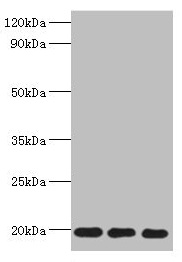
The antibody against NAA50 was raised in rabbit using the Recombinant Human N-alpha-acetyltransferase 50 protein (1-169AA) as the immunogen. This antibody exists as a non-conjugated isotype IgG, Antigen affinity purified. This antibody has been validated on ELISA, WB.
$299.00
| Cat.No | ADC-40129A | Clonality | Polyclonal |
|---|---|---|---|
| Host Species | Rabbit | Target Name | NAA50 |
| Form | Liquid | Species Reactivity | Human |
| Isotype | IgG | Storage Buffer | 50% Glycerol, PBS with 0.02% sodium azide, pH7.3. |
| Purification Method | Antigen affinity purified | Conjugate | Non-conjugated |
| Application | ELISA, WB | Storage | Upon receipt |
| Immunogen Description | Recombinant Human N-alpha-acetyltransferase 50 protein (1-169AA) | Target Species | Human |
|---|---|---|---|
| Immunogen Sequence | Complete sequences for the immunogen, target protein, and peptides are available upon request. | Uniprot ID | Q9GZZ1 |
Uniprot Id
Q9GZZ1
Target Species
Human
Target Name
NAA50
Target Full Name
N-alpha-acetyltransferase 50
Target Function
N-alpha-acetyltransferase that acetylates the N-terminus of proteins that retain their initiating methionine. Has a broad substrate specificity: able to acetylate the initiator methionine of most peptides, except for those with a proline in second position. Also displays N-epsilon-acetyltransferase activity by mediating acetylation of the side chain of specific lysines on proteins. Autoacetylates in vivo. The relevance of N-epsilon-acetyltransferase activity is however unclear: able to acetylate H4 in vitro, but this result has not been confirmed in vivo. Component of N-alpha-acetyltransferase complexes containing NAA10 and NAA15, which has N-alpha-acetyltransferase activity. Does not influence the acetyltransferase activity of NAA10. However, it negatively regulates the N-alpha-acetyltransferase activity of the N-terminal acetyltransferase A complex (also called the NatA complex). The multiprotein complexes probably constitute the major contributor for N-terminal acetylation at the ribosome exit tunnel, with NAA10 acetylating all amino termini that are devoid of methionine and NAA50 acetylating other peptides. Required for sister chromatid cohesion during mitosis by promoting binding of CDCA5/sororin to cohesin: may act by counteracting the function of NAA10.
Target Subcellular Location
Cytoplasm. Nucleus.
Target Protein Families
Acetyltransferase family, GNAT subfamily
Target Research Area
Cell Biology
Target Synonyms
AK3; FLJ13194; hNAT5; hSAN; Mak3 homolog (S. cerevisiae); Mak3 homolog; N-acetyltransferase 13 (GCN5-related); N-acetyltransferase 13; N-acetyltransferase 5; N-acetyltransferase san homolog; N-alpha-acetyltransferase 50; N-alpha-acetyltransferase 50; NatE catalytic subunit; Naa50; NAA50_HUMAN; NAT 5; NAT13; NAT5; NatE catalytic subunit; San
Target Background
Enables H4 histone acetyltransferase activity; peptide alpha-N-acetyltransferase activity; and peptidyl-lysine acetyltransferase activity. Involved in N-terminal protein amino acid acetylation; establishment of mitotic sister chromatid cohesion; and mitotic sister chromatid cohesion, centromeric. Located in cytosol and nucleus. Part of NatA complex.
Notification