-
Chinese (Simplified)
-
English
-
German
-
Korean
-
Spanish

Chinese (Simplified)
English
German
Korean
Spanish
Sign up for an account to enjoy easy online shopping and instant order tracking.
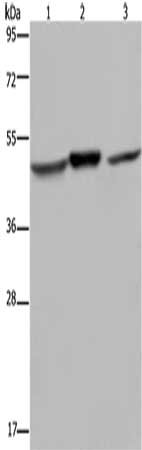
The antibody against NDUFS2 was raised in rabbit using the Synthetic peptide of Human NDUFS2 as the immunogen. This antibody exists as a non-conjugated isotype IgG, Antigen affinity purified. This antibody has been validated on ELISA, WB, IHC.
$299.00
| Cat.No | ADC-26302A | Clonality | Polyclonal |
|---|---|---|---|
| Host Species | Rabbit | Target Name | NDUFS2 |
| Target Synonyms | 49kDa (NADH coenzyme Q reductase) antibody; NADH dehydrogenase [ubiquinone] iron sulfur protein 2, CI 49 antibody; CI 49kD antibody; CI-49kD antibody; Complex 1, mitochondrial respiratory chain | Form | Liquid |
| Species Reactivity | Human, Mouse, Rat | Isotype | IgG |
| Storage Buffer | 0.05% NaN3, 40% Glycerol., pH7.4 PBS | Purification Method | Antigen affinity purified |
| Conjugate | Non-conjugated | Application | ELISA, IHC, WB |
| Storage | Upon receipt |
| Immunogen Description | Synthetic peptide of Human NDUFS2 | Target Species | Human |
|---|---|---|---|
| Immunogen Sequence | Complete sequences for the immunogen, target protein, and peptides are available upon request. | Uniprot ID | O75306 |
Uniprot Id
O75306
Target Species
Human
Target Name
NDUFS2
Target Full Name
NADH dehydrogenase [ubiquinone] iron-sulfur protein 2, mitochondrial
Target Function
Core subunit of the mitochondrial membrane respiratory chain NADH dehydrogenase (Complex I) which catalyzes electron transfer from NADH through the respiratory chain, using ubiquinone as an electron acceptor. Essential for the catalytic activity of complex I. Essential for the assembly of complex I. Redox-sensitive, critical component of the oxygen-sensing pathway in the pulmonary vasculature which plays a key role in acute pulmonary oxygen-sensing and hypoxic pulmonary vasoconstriction. Plays an important role in carotid body sensing of hypoxia. Essential for glia-like neural stem and progenitor cell proliferation, differentiation and subsequent oligodendrocyte or neuronal maturation.
Target Involvement
Mitochondrial complex I deficiency (MT-C1D)
Target Subcellular Location
Mitochondrion inner membrane; Peripheral membrane protein; Matrix side.
Target Protein Families
Complex I 49 kDa subunit family
Target Synonyms
CI 49; CI 49kD ; CI-49kD; Complex 1, mitochondrial respiratory chain, 49 KD subunit; Complex I 49kD; Complex I 49kDa subunit; Complex I-49kD; mitochondrial; NADH dehydrogenase (ubiquinone) Fe S protein 2 49kDa; NADH dehydrogenase (ubiquinone) Fe S protein 2, 49kDa (NADH coenzyme Q reductase); NADH dehydrogenase [ubiquinone] iron sulfur protein 2, mitochondrial ; NADH dehydrogenase [ubiquinone] iron-sulfur protein 2; NADH ubiquinone oxidoreductase 49 kDa subunit; NADH ubiquinone oxidoreductase NDUFS2 subunit; NADH-ubiquinone oxidoreductase 49 kDa subunit; NADH:ubiquinone oxidoreductase core subunit S2; Ndufs2; NDUS2_HUMAN
Target Background
The protein encoded by this gene is a core subunit of the mitochondrial membrane respiratory chain NADH dehydrogenase (complex I). Mammalian mitochondrial complex I is composed of at least 43 different subunits, 7 of which are encoded by the mitochondrial genome, and the rest are the products of nuclear genes. The iron-sulfur protein fraction of complex I is made up of 7 subunits, including this gene product. Complex I catalyzes the NADH oxidation with concomitant ubiquinone reduction and proton ejection out of the mitochondria. Mutations in this gene are associated with mitochondrial complex I deficiency. Alternatively spliced transcript variants encoding different isoforms have been found for this gene.
Notification