-
Chinese (Simplified)
-
English
-
German
-
Korean
-
Spanish
Chinese (Simplified)
English
German
Korean
Spanish
Sign up for an account to enjoy easy online shopping and instant order tracking.
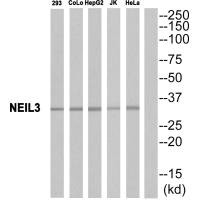
The antibody against NEIL3 was raised in rabbit using the Synthesized peptide derived from internal of Human NEIL3. as the immunogen. The antibody was affinity-purified from rabbit antiserum by affinity-chromatography using epitope-specific immunogen. This antibody has been validated on ELISA, WB.
$297.00
| Cat.No | ADC-41246A | Clonality | Polyclonal |
|---|---|---|---|
| Host Species | Rabbit | Target Name | NEIL3 |
| Form | Liquid | Species Reactivity | Human |
| Storage Buffer | PH 7.4, 0.02% sodium azide and 50% glycerol., 150mM NaCl, Rabbit IgG in phosphate buffered saline (without Mg2+ and Ca2+) | Purification Method | The antibody was affinity-purified from rabbit antiserum by affinity-chromatography using epitope-specific immunogen. |
| Application | ELISA, WB | Storage | Upon receipt |
| Immunogen Description | Synthesized peptide derived from internal of Human NEIL3. | Target Species | Human |
|---|---|---|---|
| Immunogen Sequence | Complete sequences for the immunogen, target protein, and peptides are available upon request. | Uniprot ID | Q8TAT5 |
Uniprot Id
Q8TAT5
Target Species
Human
Target Name
NEIL3
Target Full Name
Endonuclease 8-like 3
Target Function
DNA glycosylase which prefers single-stranded DNA (ssDNA), or partially ssDNA structures such as bubble and fork structures, to double-stranded DNA (dsDNA). Mediates interstrand cross-link repair in response to replication stress: acts by mediating DNA glycosylase activity, cleaving one of the two N-glycosyl bonds comprising the interstrand cross-link, which avoids the formation of a double-strand break but generates an abasic site that is bypassed by translesion synthesis polymerases. In vitro, displays strong glycosylase activity towards the hydantoin lesions spiroiminodihydantoin (Sp) and guanidinohydantoin (Gh) in both ssDNA and dsDNA; also recognizes FapyA, FapyG, 5-OHU, 5-OHC, 5-OHMH, Tg and 8-oxoA lesions in ssDNA. No activity on 8-oxoG detected. Also shows weak DNA-(apurinic or apyrimidinic site) lyase activity. In vivo, appears to be the primary enzyme involved in removing Sp and Gh from ssDNA in neonatal tissues.
Target Subcellular Location
Nucleus. Chromosome.
Target Protein Families
FPG family
Target Tissue Specificity
Expressed in keratinocytes and embryonic fibroblasts (at protein level). Also detected in thymus, testis and fetal lung primary fibroblasts.
Target Synonyms
123; AI449477; BC034753; C85903; DNA glycosylase FPG2; DNA glycosylase hFPG2; DNA glycosylase/AP lyase Neil3; EC 3.2.2.-; EC 4.2.99.18; Endonuclease 8-like 3; Endonuclease VIII-like 3; FGP2; FLJ10858; FPG2 ; hFPG2; hNEI3; MGC27861; MGC36916; Nei endonuclease VIII-like 3 (E. coli); nei endonuclease VIII-like 3; Nei like 3 (E. coli); Nei-like protein 3; NEI3; NEIL3; NEIL3_HUMAN; OTTHUMP00000218810; RGD1310562
Notification