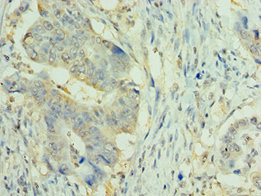
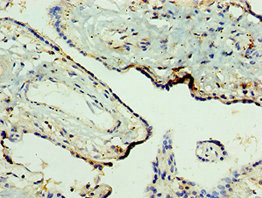
-
Chinese (Simplified)
-
English
-
German
-
Korean
-
Spanish
Chinese (Simplified)
English
German
Korean
Spanish
Sign up for an account to enjoy easy online shopping and instant order tracking.
The antibody against NLRP2 was raised in rabbit using the Recombinant Human NACHT, LRR and PYD domains-containing protein 2 protein (1-220AA) as the immunogen. This antibody exists as a non-conjugated isotype IgG, Antigen affinity purified. This antibody has been validated on ELISA, IHC.
$299.00
| Cat.No | ADC-40050A | Clonality | Polyclonal |
|---|---|---|---|
| Host Species | Rabbit | Target Name | NLRP2 |
| Form | Liquid | Species Reactivity | Human |
| Isotype | IgG | Storage Buffer | 50% Glycerol, PBS with 0.02% sodium azide, pH7.3. |
| Purification Method | Antigen affinity purified | Conjugate | Non-conjugated |
| Application | ELISA, IHC | Storage | Upon receipt |
| Immunogen Description | Recombinant Human NACHT, LRR and PYD domains-containing protein 2 protein (1-220AA) | Target Species | Human |
|---|---|---|---|
| Immunogen Sequence | Complete sequences for the immunogen, target protein, and peptides are available upon request. | Uniprot ID | Q9NX02 |
Uniprot Id
Q9NX02
Target Species
Human
Target Name
NLRP2
Target Full Name
NACHT, LRR and PYD domains-containing protein 2
Target Function
Suppresses TNF- and CD40-induced NFKB1 activity at the level of the IKK complex, by inhibiting NFKBIA degradation induced by TNF. When associated with PYCARD, activates CASP1, leading to the secretion of mature proinflammatory cytokine IL1B. May be a component of the inflammasome, a protein complex which also includes PYCARD, CARD8 and CASP1 and whose function would be the activation of proinflammatory caspases.
Target Subcellular Location
Cytoplasm.
Target Protein Families
NLRP family
Target Tissue Specificity
Expressed at high levels in lung, placenta and thymus and at lower levels in ovary, intestine and brain. Highly abundant in oocytes and early embryos, however poorly expressed in somatic tissues such as brain, kidney, liver and spinal cord.
Target Synonyms
CLR19.9; FLJ20510; Leucine rich repeat and PYD containing protein 2; LRR and PYD domains-containing protein 2; NACHT; NACHT domain; NACHT leucine rich repeat and PYD containing 2; NACHT LRR and PYD domains containing protein 2; NALP2; NALP2_HUMAN; NBS1; NLR family pyrin domain containing 2; NLRP2; Nucleotide binding oligomerization domain leucine rich repeat and pyrin domain containing 2; Nucleotide-binding site protein 1; PAN1; PYPAF2; PYRIN containing APAF1 like protein2; PYRIN domain and NACHT domain-containing protein 1; PYRIN-containing APAF1-like protein 2
Target Background
This gene is a member of the nucleotide-binding and leucine-rich repeat receptor (NLR) family, and is predicted to contain an N-terminal pyrin effector domain (PYD), a centrally-located nucleotide-binding and oligomerization domain (NACHT) and C-terminal leucine-rich repeats (LRR). Members of this gene family are thought to be important regulators of immune responses. This gene product interacts with components of the IkB kinase (IKK) complex, and can regulate both caspase-1 and NF-kB (nuclear factor kappa-light-chain-enhancer of activated B cells) activity. The pyrin domain is necessary and sufficient for suppression of NF-kB activity. An allelic variant (rs147585490) has been found that is incapable of blocking the transcriptional activity of NF-kB. Alternative splicing results in multiple transcript variants encoding different isoforms.
Notification