• Contact info@abtriva.com for inquiries and orders.
  • Chinese (Simplified)

  • English

  • German

  • Korean

  • Spanish

United States (English / $ USD)

Rabbit anti-Human NOD2 Polyclonal Antibody

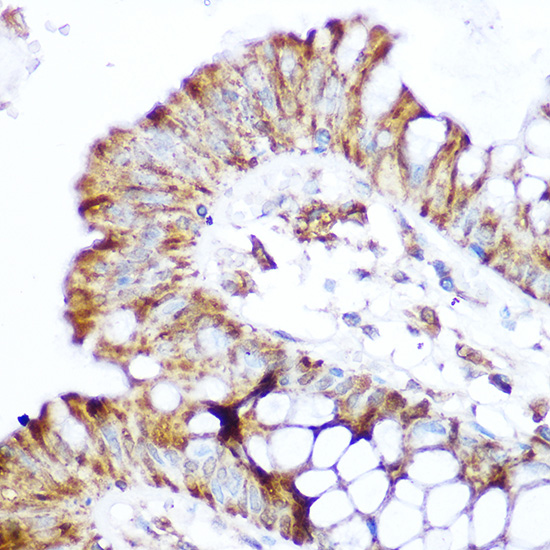
The antibody against NOD2 was raised in Rabbit using the recombinant fusion protein containing a sequence corresponding to amino acids 30-216 of human NOD2 (NP_071445.1) as the immunogen. The polyclonal antibody exists as a isotype IgG, by affinity purification. This antibody has been validated on WB, IHC-P, IF/ICC, ELISA.

ADA-12659A

The antibody against NOD2 was raised in Rabbit using the recombinant fusion protein containing a sequence corresponding to amino acids 30-216 of human NOD2 (NP_071445.1) as the immunogen. The polyclonal antibody exists as a isotype IgG, by affinity purification. This antibody has been validated on WB, IHC-P, IF/ICC, ELISA.

Number
Order Exclusive Products Now

Request a Quote
High Purity LevelsPrecision and ReliabilityCustomization Options

Specifications


Cat.No ADA-12659A ClonalityPolyclonal
Host SpeciesRabbitTarget NameNOD2
Target SynonymsCD; ACUG; BLAU; IBD1; YAOS; BLAUS; NLRC2; NOD2B; CARD15; CLR16.3; PSORAS1; NOD2FormLiquid
Species ReactivityHuman, Mouse, RatIsotypeIgG
Storage Buffer50% Glycerol, PBS with 0.01% thimerosal, pH7.3.Purification MethodAffinity purification
Positive SamplesMouse kidney, Rat spleenApplicationELISA, WB, IF/ICC, IHC-P

Immunogen Information


Immunogen DescriptionRecombinant fusion protein containing a sequence corresponding to amino acids 30-216 of human NOD2 (NP_071445.1).Target SpeciesHuman
Immunogen SequenceSQEAFQAQRSQLVELLVSGSLEGFESVLDWLLSWEVLSWEDYEGFHLLGQPLSHLARRLLDTVWNKGTWACQKLIAAAQEAQADSQSPKLHGCWDPHSLHPARDLQSHRPAIVRRLHSHVENMLDLAWERGFVSQYECDEIRLPIFTPSQRARRLLDLATVKANGLAAFLLQHVQELPVPLALPLEAUniprot IDQ9HC29
Background Information
  • Uniprot Id

    Q9HC29

  • Target Species

    Human

  • Target Name

    NOD2

  • Target Full Name

    Nucleotide-binding oligomerization domain-containing protein 2

  • Target Function

    Involved in gastrointestinal immunity. Upon stimulation by muramyl dipeptide (MDP), a fragment of bacterial peptidoglycan, binds the proximal adapter receptor-interacting RIPK2, which recruits ubiquitin ligases as XIAP, BIRC2, BIRC3, INAVA and the LUBAC complex, triggering activation of MAP kinases and activation of NF-kappa-B signaling. This in turn leads to the transcriptional activation of hundreds of genes involved in immune response. Required for MDP-induced NLRP1-dependent CASP1 activation and IL1B release in macrophages. Component of an autophagy-mediated antibacterial pathway together with ATG16L1. Plays also a role in sensing single-stranded RNA (ssRNA) from viruses. Interacts with mitochondrial antiviral signaling/MAVS, leading to activation of interferon regulatory factor-3/IRF3 and expression of type I interferon.

  • Target Involvement

    Blau syndrome (BLAUS); Inflammatory bowel disease 1 (IBD1); Yao syndrome (YAOS)

  • Target Subcellular Location

    Cytoplasm. Membrane. Mitochondrion. Basolateral cell membrane.

  • Target Tissue Specificity

    Expressed in intestinal mucosa, mainly in Paneth cells and, at lower extent, in the glandular epithelium.

  • Target Synonyms

    ACUG; Arthrocutaneouveal granulomatosis ; BLAU; CARD15; Caspase recruitment domain family, member 15; Caspase recruitment domain protein 15; Caspase recruitment domain-containing protein 15; CD; CLR16.3; IBD1; Inflammatory bowel disease protein 1; LRR containing protein; NLR family, CARD domain containing 2; NLRC2; NOD like receptor C2; NOD2; NOD2 protein; NOD2_HUMAN; NOD2B; nucleotide binding oligomerization domain 2; Nucleotide binding oligomerization domain containing 2; Nucleotide binding oligomerization domain, leucine rich repeat and CARD domain containing 2; Nucleotide-binding oligomerization domain-containing protein 2; PSORAS1

  • Target Background

    This gene is a member of the Nod1/Apaf-1 family and encodes a protein with two caspase recruitment (CARD) domains and six leucine-rich repeats (LRRs). The protein is primarily expressed in the peripheral blood leukocytes. It plays a role in the immune response to intracellular bacterial lipopolysaccharides (LPS) by recognizing the muramyl dipeptide (MDP) derived from them and activating the NFKB protein. Mutations in this gene have been associated with Crohn disease and Blau syndrome. Alternatively spliced transcript variants encoding distinct isoforms have been found for this gene.

Inquire Rabbit anti-Human NOD2 Polyclonal Antibody Now


AbTriva respects your privacy and protects your personal data in accordance with AbTriva. For more information, please see our data protection statement. *

Notification