-
Chinese (Simplified)
-
English
-
German
-
Korean
-
Spanish
Chinese (Simplified)
English
German
Korean
Spanish
Sign up for an account to enjoy easy online shopping and instant order tracking.
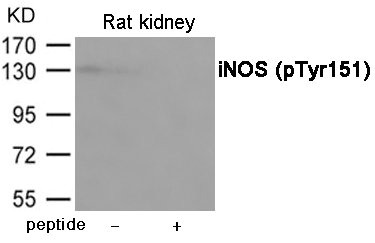
The antibody against NOS2 was raised in rabbit using the Peptide sequence around phosphorylation site of Tyrosine 151(Q-Y-Y(p)-G-S) derived from Human iNOS. as the immunogen. Antibodies were produced by immunizing rabbits with synthetic phosphopeptide and KLH conjugates. Antibodies were purified by affinity-chromatography using epitope-specific phosphopeptide. Non-phospho specific antibodies were removed by chromatogramphy usi This antibody has been validated on ELISA, WB.
$360.00
| Cat.No | ADC-42958A | Clonality | Polyclonal |
|---|---|---|---|
| Host Species | Rabbit | Target Name | NOS2 |
| Target Synonyms | Hepatocyte antibody; Peptidyl-cysteine S-nitrosylase NOS2 antibody, hepatocytes) antibody; Nitric oxide synthase antibody; Nitric oxide synthase inducible antibody; nitric oxide synthase, Inducible, macrophage antibody; NOS 2 antibody; NOS antibody; Nos II antibody; NOS type II antibody; nos2 antibody; NOS2_HUMAN antibody; NOS2A antibody; NOS2A | Form | Liquid |
| Species Reactivity | Human, Mouse, Rat | Storage Buffer | PH 7.4, 0.02% sodium azide and 50% glycerol., 150mM NaCl, Supplied at 1.0mg/mL in phosphate buffered saline (without Mg2+ and Ca2+) |
| Application | ELISA, WB | Storage | Upon receipt |
| Immunogen Description | Peptide sequence around phosphorylation site of tyrosine 151(Q-Y-Y(p)-G-S) derived from Human iNOS . | Target Species | Human |
|---|---|---|---|
| Immunogen Sequence | Complete sequences for the immunogen, target protein, and peptides are available upon request. | Uniprot ID | P35228 |
Uniprot Id
P35228
Target Species
Human
Target Name
NOS2
Target Full Name
Nitric oxide synthase, inducible
Target Function
Produces nitric oxide (NO) which is a messenger molecule with diverse functions throughout the body. In macrophages, NO mediates tumoricidal and bactericidal actions. Also has nitrosylase activity and mediates cysteine S-nitrosylation of cytoplasmic target proteins such PTGS2/COX2. As component of the iNOS-S100A8/9 transnitrosylase complex involved in the selective inflammatory stimulus-dependent S-nitrosylation of GAPDH on 'Cys-247' implicated in regulation of the GAIT complex activity and probably multiple targets including ANXA5, EZR, MSN and VIM. Involved in inflammation, enhances the synthesis of proinflammatory mediators such as IL6 and IL8.
Target Subcellular Location
Cytoplasm, cytosol.
Target Protein Families
NOS family
Target Tissue Specificity
Expressed in the liver, retina, bone cells and airway epithelial cells of the lung. Not expressed in the platelets.
Target Research Area
Cancer
Target Synonyms
HEP-NOS; Hepatocyte NOS; HEPNOS ; inducible; Inducible nitric oxide synthase ; Inducible NO synthase; Inducible NOS; iNOS; MAC NOS; Macrophage NOS; Nitric oxide synthase 2 inducible; Nitric oxide synthase 2 inducible macrophage ; nitric oxide synthase 2A (inducible, hepatocytes); Nitric oxide synthase; Nitric oxide synthase inducible ; nitric oxide synthase, macrophage; NOS 2; NOS; Nos II; NOS type II; nos2; NOS2_HUMAN; NOS2A; NOS2A, Inducible, Hepatocyte; Peptidyl-cysteine S-nitrosylase NOS2
Target Background
Nitric oxide is a reactive free radical which acts as a biologic mediator in several processes, including neurotransmission and antimicrobial and antitumoral activities. This gene encodes a nitric oxide synthase which is expressed in liver and is inducible by a combination of lipopolysaccharide and certain cytokines. Three related pseudogenes are located within the Smith-Magenis syndrome region on chromosome 17.
Notification