• Contact info@abtriva.com for inquiries and orders.
  • Chinese (Simplified)

  • English

  • German

  • Korean

  • Spanish

United States (English / $ USD)

Rabbit anti-Human OAZ1 Polyclonal Antibody

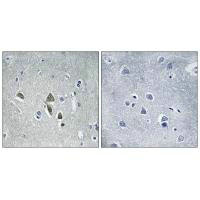
The antibody against OAZ1 was raised in rabbit using the Synthesized peptide derived from N-terminal of Human OAZ1. as the immunogen. The antibody was affinity-purified from rabbit antiserum by affinity-chromatography using epitope-specific immunogen. This antibody has been validated on ELISA, IHC.

ADC-41059A

The antibody against OAZ1 was raised in rabbit using the Synthesized peptide derived from N-terminal of Human OAZ1. as the immunogen. The antibody was affinity-purified from rabbit antiserum by affinity-chromatography using epitope-specific immunogen. This antibody has been validated on ELISA, IHC.

$297.00

Number
Order Exclusive Products Now

Request a Quote
High Purity LevelsPrecision and ReliabilityCustomization Options

Specifications


Cat.No ADC-41059A ClonalityPolyclonal
Host SpeciesRabbitTarget NameOAZ1
FormLiquidSpecies ReactivityHuman, Mouse
Storage BufferPH 7.4, 0.02% sodium azide and 50% glycerol., 150mM NaCl, Rabbit IgG in phosphate buffered saline (without Mg2+ and Ca2+)Purification MethodThe antibody was affinity-purified from rabbit antiserum by affinity-chromatography using epitope-specific immunogen.
ApplicationELISA, IHCStorageUpon receipt

Immunogen Information


Immunogen DescriptionSynthesized peptide derived from N-terminal of Human OAZ1.Target SpeciesHuman
Immunogen SequenceComplete sequences for the immunogen, target protein, and peptides are available upon request.Uniprot IDP54368
Background Information
  • Uniprot Id

    P54368

  • Target Species

    Human

  • Target Name

    OAZ1

  • Target Full Name

    Ornithine decarboxylase antizyme 1

  • Target Function

    Ornithine decarboxylase (ODC) antizyme protein that negatively regulates ODC activity and intracellular polyamine biosynthesis and uptake in response to increased intracellular polyamine levels. Binds to ODC monomers, inhibiting the assembly of the functional ODC homodimer, and targets the monomers for ubiquitin-independent proteolytic destruction by the 26S proteasome. Triggers ODC degradation by inducing the exposure of a cryptic proteasome-interacting surface of ODC. Stabilizes AZIN2 by interfering with its ubiquitination. Also inhibits cellular uptake of polyamines by inactivating the polyamine uptake transporter. SMAD1/OAZ1/PSMB4 complex mediates the degradation of the CREBBP/EP300 repressor SNIP1. Involved in the translocation of AZIN2 from ER-Golgi intermediate compartment (ERGIC) to the cytosol.

  • Target Protein Families

    ODC antizyme family

  • Target Synonyms

    Antizyme 1; Antizyme; AZI; MGC138338; OAZ 1; OAZ; OAZ1; OAZ1_HUMAN; ODC Az; ODC-Az; Ornithine decarboxylase antizyme 1; Ornithine decarboxylase antizyme

  • Target Background

    The protein encoded by this gene belongs to the ornithine decarboxylase antizyme family, which plays a role in cell growth and proliferation by regulating intracellular polyamine levels. Expression of antizymes requires +1 ribosomal frameshifting, which is enhanced by high levels of polyamines. Antizymes in turn bind to and inhibit ornithine decarboxylase (ODC), the key enzyme in polyamine biosynthesis; thus, completing the auto-regulatory circuit. This gene encodes antizyme 1, the first member of the antizyme family, that has broad tissue distribution, and negatively regulates intracellular polyamine levels by binding to and targeting ODC for degradation, as well as inhibiting polyamine uptake. Antizyme 1 mRNA contains two potential in-frame AUGs; and studies in rat suggest that alternative use of the two translation initiation sites results in N-terminally distinct protein isoforms with different subcellular localization. Alternatively spliced transcript variants have also been noted for this gene.

Inquire Rabbit anti-Human OAZ1 Polyclonal Antibody Now


AbTriva respects your privacy and protects your personal data in accordance with AbTriva. For more information, please see our data protection statement. *

Notification