-
Chinese (Simplified)
-
English
-
German
-
Korean
-
Spanish
Chinese (Simplified)
English
German
Korean
Spanish
Sign up for an account to enjoy easy online shopping and instant order tracking.
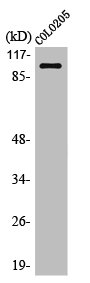
The antibody against OCRL was raised in rabbit using the Synthesized peptide derived from the Internal region of Human OCRL. as the immunogen. This antibody exists as a non-conjugated isotype IgG. The antibody was affinity-purified from rabbit antiserum by affinity-chromatography using epitope-specific immunogen. This antibody has been validated on WB, ELISA.
$167.00
| Cat.No | ADC-38042A | Clonality | Polyclonal |
|---|---|---|---|
| Host Species | Rabbit | Target Name | OCRL |
| Form | Liquid | Species Reactivity | Human, Mouse |
| Isotype | IgG | Storage Buffer | 0.5% BSA and 0.02% sodium azide., Liquid in PBS containing 50% glycerol |
| Purification Method | The antibody was affinity-purified from rabbit antiserum by affinity-chromatography using epitope-specific immunogen. | Conjugate | Non-conjugated |
| Application | ELISA, WB | Storage | Upon receipt |
| Immunogen Description | Synthesized peptide derived from the Internal region of Human OCRL. | Target Species | Human |
|---|---|---|---|
| Immunogen Sequence | Complete sequences for the immunogen, target protein, and peptides are available upon request. | Uniprot ID | Q01968 |
Uniprot Id
Q01968
Target Species
Human
Target Name
OCRL
Target Full Name
Inositol polyphosphate 5-phosphatase OCRL
Target Function
Catalyzes the hydrolysis of the 5-position phosphate of phosphatidylinositol 4,5-bisphosphate (PtdIns(4,5)P2) and phosphatidylinositol-3,4,5-bisphosphate (PtdIns(3,4,5)P3), with the greatest catalytic activity towards PtdIns(4,5)P2. Able also to hydrolyze the 5-phosphate of inositol 1,4,5-trisphosphate and of inositol 1,3,4,5-tetrakisphosphate. Regulates traffic in the endosomal pathway by regulating the specific pool of phosphatidylinositol 4,5-bisphosphate that is associated with endosomes. Involved in primary cilia assembly. Acts as a regulator of phagocytosis, hydrolyzing PtdIns(4,5)P2 to promote phagosome closure, through attenuation of PI3K signaling.
Target Involvement
Lowe oculocerebrorenal syndrome (OCRL); Dent disease 2 (DD2)
Target Subcellular Location
Cytoplasmic vesicle, phagosome membrane. Early endosome membrane. Membrane, clathrin-coated pit. Cell projection, cilium, photoreceptor outer segment. Cell projection, cilium. Cytoplasmic vesicle. Endosome. Golgi apparatus, trans-Golgi network. Lysosome.
Target Protein Families
Inositol 1,4,5-trisphosphate 5-phosphatase type II family
Target Tissue Specificity
Brain, skeletal muscle, heart, kidney, lung, placenta and fibroblasts. Expressed in the retina and the retinal pigment epithelium.
Target Synonyms
EC 3.1.3.36; Inositol polyphosphate 5 phosphatase OCRL 1; Inositol polyphosphate 5 phosphatase OCRL1; Inositol polyphosphate 5-phosphatase OCRL-1; INPP5F; LOCR ; Lowe oculocerebrorenal syndrome protein; NPHL2; OCRL 1; OCRL; OCRL_HUMAN; OCRL1; Oculocerebrorenal syndrome of Lowe; Phosphatidylinositol polyphosphate 5 phosphatase
Target Background
This gene encodes an inositol polyphosphate 5-phosphatase. This protein is involved in regulating membrane trafficking and is located in numerous subcellular locations including the trans-Golgi network, clathrin-coated vesicles and, endosomes and the plasma membrane. This protein may also play a role in primary cilium formation. Mutations in this gene cause oculocerebrorenal syndrome of Lowe and also Dent disease. Alternate splicing results in multiple transcript variants.
Notification