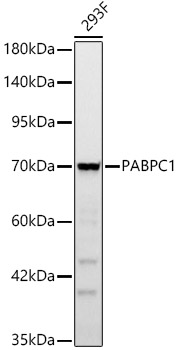
-
Chinese (Simplified)
-
English
-
German
-
Korean
-
Spanish
Chinese (Simplified)
English
German
Korean
Spanish
Sign up for an account to enjoy easy online shopping and instant order tracking.
The antibody against PABPC1 was raised in Rabbit using a synthetic peptide corresponding to a sequence within amino acids 390-490 of human PABPC1 (NP_002559.2?) as the immunogen. The monoclonal antibody exists as a isotype IgG, by affinity purification. This antibody has been validated on WB, IHC-P, IF/ICC, IP, ELISA.
| Cat.No | ADA-15542A | Clonality | Monoclonal |
|---|---|---|---|
| Host Species | Rabbit | Target Name | PABPC1 |
| Target Synonyms | PAB1; PABP; PABP1; PABPC2; PABPL1; pAbPC1 | Form | Liquid |
| Species Reactivity | Human, Mouse, Rat | Isotype | IgG |
| Storage Buffer | 50% Glycerol, 0.05% BSA, PBS with 0.05% proclin300, pH7.3. | Purification Method | Affinity purification |
| Positive Samples | 293F | Application | ELISA, WB, IF/ICC, IHC-P, IP |
| Immunogen Description | A synthetic peptide corresponding to a sequence within amino acids 390-490 of human PABPC1 (NP_002559.2?). | Target Species | Human |
|---|---|---|---|
| Immunogen Sequence | RAVPNPVINPYQPAPPSGYFMAAIPQTQNRAAYYPPSQIAQLRPSPRWTAQGARPHPFQNMPGAIRPAAPRPPFSTMRPASSQVPRVMSTQRVANTSTQTM | Uniprot ID | P11940 |
Uniprot Id
P11940
Target Species
Human
Target Name
PABPC1
Target Full Name
Polyadenylate-binding protein 1
Target Function
Binds the poly(A) tail of mRNA, including that of its own transcript, and regulates processes of mRNA metabolism such as pre-mRNA splicing and mRNA stability. Its function in translational initiation regulation can either be enhanced by PAIP1 or repressed by PAIP2. Can probably bind to cytoplasmic RNA sequences other than poly(A) in vivo. Involved in translationally coupled mRNA turnover. Implicated with other RNA-binding proteins in the cytoplasmic deadenylation/translational and decay interplay of the FOS mRNA mediated by the major coding-region determinant of instability (mCRD) domain. Involved in regulation of nonsense-mediated decay (NMD) of mRNAs containing premature stop codons; for the recognition of premature termination codons (PTC) and initiation of NMD a competitive interaction between UPF1 and PABPC1 with the ribosome-bound release factors is proposed. By binding to long poly(A) tails, may protect them from uridylation by ZCCHC6/ZCCHC11 and hence contribute to mRNA stability.; (Microbial infection) Positively regulates the replication of dengue virus (DENV).
Target Subcellular Location
Cytoplasm. Cytoplasm, Stress granule. Nucleus. Cell projection, lamellipodium.
Target Protein Families
Polyadenylate-binding protein type-1 family
Target Tissue Specificity
Ubiquitous.
Target Synonyms
PABPC1; PAB1; PABP1; PABPC2; Polyadenylate-binding protein 1; PABP-1; Poly(A)-binding protein 1
Target Background
This gene encodes a poly(A) binding protein. The protein shuttles between the nucleus and cytoplasm and binds to the 3' poly(A) tail of eukaryotic messenger RNAs via RNA-recognition motifs. The binding of this protein to poly(A) promotes ribosome recruitment and translation initiation; it is also required for poly(A) shortening which is the first step in mRNA decay. The gene is part of a small gene family including three protein-coding genes and several pseudogenes.
Notification