• Contact info@abtriva.com for inquiries and orders.
  • Chinese (Simplified)

  • English

  • German

  • Korean

  • Spanish

United States (English / $ USD)

Rabbit anti-Human PARVA Polyclonal Antibody

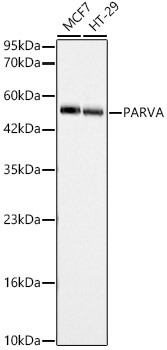
The antibody against PARVA was raised in Rabbit using a synthetic peptide corresponding to a sequence within amino acids 1-100 of human PARVA (NP_060692.3) as the immunogen. The polyclonal antibody exists as a isotype IgG, by affinity purification. This antibody has been validated on WB, ELISA.

ADA-08233A

The antibody against PARVA was raised in Rabbit using a synthetic peptide corresponding to a sequence within amino acids 1-100 of human PARVA (NP_060692.3) as the immunogen. The polyclonal antibody exists as a isotype IgG, by affinity purification. This antibody has been validated on WB, ELISA.

Number
Order Exclusive Products Now

Request a Quote
High Purity LevelsPrecision and ReliabilityCustomization Options

Specifications


Cat.No ADA-08233A ClonalityPolyclonal
Host SpeciesRabbitTarget NamePARVA
Target SynonymsPARVA; CH-ILKBP; MXRA2; alpha-parvinFormLiquid
Species ReactivityHuman, Mouse, RatIsotypeIgG
Storage Buffer50% Glycerol, PBS with 0.05% proclin300, pH7.3.Purification MethodAffinity purification
Positive SamplesHT-29, MCF7ApplicationELISA, WB

Immunogen Information


Immunogen DescriptionA synthetic peptide corresponding to a sequence within amino acids 1-100 of human PARVA (NP_060692.3) .Target SpeciesHuman
Immunogen SequenceMATSPQKSPSVPKSPTPKSPPSRKKDDSFLGKLGGTLARRKKAKEVSELQEEGMNAINLPLSPIPFELDPEDTMLEENEVRTMVDPNSRSDPKLQELMKVUniprot IDQ9NVD7
Background Information
  • Uniprot Id

    Q9NVD7

  • Target Species

    Human

  • Target Name

    PARVA

  • Target Full Name

    Alpha-parvin

  • Target Function

    Plays a role in sarcomere organization and in smooth muscle cell contraction. Required for normal development of the embryonic cardiovascular system, and for normal septation of the heart outflow tract. Plays a role in sprouting angiogenesis and is required for normal adhesion of vascular smooth muscle cells to endothelial cells during blood vessel development. Plays a role in the reorganization of the actin cytoskeleton, formation of lamellipodia and ciliogenesis. Plays a role in the establishment of cell polarity, cell adhesion, cell spreading, and directed cell migration.

  • Target Subcellular Location

    Cell junction, focal adhesion. Cell membrane; Peripheral membrane protein; Cytoplasmic side. Cytoplasm, cytoskeleton. Cytoplasm, myofibril, sarcomere, Z line. Note=Constituent of focal adhesions. Associates with the actin cytoskeleton.

  • Target Protein Families

    Parvin family

  • Target Tissue Specificity

    Widely expressed, with highest levels in heart, skeletal muscle, kidney and liver.

  • Target Synonyms

    Actopaxin; Alpha parvin; Alpha-parvin; Calponin like integrin linked kinase binding protein; Calponin-like integrin-linked kinase-binding protein; CH ILKBP; CH-ILKBP; FLJ10793; FLJ12254; Matrix remodelling associated 2; Matrix remodelling associated protein 2; Matrix-remodeling-associated protein 2; MXRA 2; MXRA2; PARV A; Parva; PARVA_HUMAN

  • Target Background

    This gene encodes a member of the parvin family of actin-binding proteins. Parvins are associated with focal contacts and contain calponin homology domains that bind to actin filaments. The encoded protein is part of the integrin-linked kinase signaling complex and plays a role in cell adhesion, motility and survival.

Inquire Rabbit anti-Human PARVA Polyclonal Antibody Now


AbTriva respects your privacy and protects your personal data in accordance with AbTriva. For more information, please see our data protection statement. *

Notification