• Contact info@abtriva.com for inquiries and orders.
  • Chinese (Simplified)

  • English

  • German

  • Korean

  • Spanish

United States (English / $ USD)

Rabbit anti-Human PAX5 Polyclonal Antibody

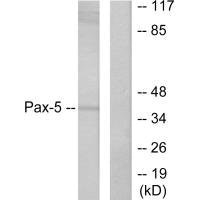
The antibody against PAX5 was raised in rabbit using the Synthesized peptide derived from Human Pax-5 antibody. as the immunogen. The antibody was affinity-purified from rabbit antiserum by affinity-chromatography using epitope-specific immunogen. This antibody has been validated on ELISA, WB.

ADC-42335A

The antibody against PAX5 was raised in rabbit using the Synthesized peptide derived from Human Pax-5 antibody. as the immunogen. The antibody was affinity-purified from rabbit antiserum by affinity-chromatography using epitope-specific immunogen. This antibody has been validated on ELISA, WB.

$297.00

Number
Order Exclusive Products Now

Request a Quote
High Purity LevelsPrecision and ReliabilityCustomization Options

Specifications


Cat.No ADC-42335A ClonalityPolyclonal
Host SpeciesRabbitTarget NamePAX5
FormLiquidSpecies ReactivityHuman, Mouse
Storage BufferPH 7.4, 0.02% sodium azide and 50% glycerol., 150mM NaCl, Rabbit IgG in phosphate buffered saline (without Mg2+ and Ca2+)Purification MethodThe antibody was affinity-purified from rabbit antiserum by affinity-chromatography using epitope-specific immunogen.
ApplicationELISA, WBStorageUpon receipt

Immunogen Information


Immunogen DescriptionSynthesized peptide derived from Human Pax-5 antibody.Target SpeciesHuman
Immunogen SequenceComplete sequences for the immunogen, target protein, and peptides are available upon request.Uniprot IDQ02548
Background Information
  • Uniprot Id

    Q02548

  • Target Species

    Human

  • Target Name

    PAX5

  • Target Full Name

    Paired box protein Pax-5

  • Target Function

    Transcription factor that plays an essential role in commitment of lymphoid progenitors to the B-lymphocyte lineage. Fulfills a dual role by repressing B-lineage inappropriate genes and simultaneously activating B-lineage-specific genes. In turn, regulates cell adhesion and migration, induces V(H)-to-D(H)J(H) recombination, facilitates pre-B-cell receptor signaling and promotes development to the mature B-cell stage. Repression of the cohesin-release factor WAPL causes global changes of the chromosomal architecture in pro-B cells to facilitate the generation of a diverse antibody repertoire.; (Microbial infection) Plays an essential role in the maintenance of Epstein-Barr virus genome copy number within the host cell by promoting EBNA1/oriP-dependent binding and transcription. Participates also in the inhibition of lytic EBV reactivation by modulating viral BZLF1 activity.

  • Target Involvement

    Leukemia, acute lymphoblastic, 3 (ALL3)

  • Target Subcellular Location

    Nucleus.

  • Target Research Area

    Epigenetics and Nuclear Signaling

  • Target Synonyms

    B cell lineage specific activator; B cell lineage specific activator protein; B cell specific activator protein; B cell specific transcription factor; B-cell-specific transcription factor; BSAP; EBB-1; KLP; Paired box 5; Paired box gene 5 (B cell lineage specific activator protein); Paired box gene 5 (B cell lineage specific activator); Paired box gene 5; Paired box homeotic gene 5; Paired box protein Pax 5; Paired box protein Pax-5; Paired domain gene 5; PAX 5; PAX5; PAX5_HUMAN; Transcription factor PAX 5

  • Target Background

    This gene encodes a member of the paired box (PAX) family of transcription factors. The central feature of this gene family is a novel, highly conserved DNA-binding motif, known as the paired box. Paired box transcription factors are important regulators in early development, and alterations in the expression of their genes are thought to contribute to neoplastic transformation. This gene encodes the B-cell lineage specific activator protein that is expressed at early, but not late stages of B-cell differentiation. Its expression has also been detected in developing CNS and testis and so the encoded protein may also play a role in neural development and spermatogenesis. This gene is located at 9p13, which is involved in t(9;14)(p13;q32) translocations recurring in small lymphocytic lymphomas of the plasmacytoid subtype, and in derived large-cell lymphomas. This translocation brings the potent E-mu enhancer of the IgH gene into close proximity of the PAX5 promoter, suggesting that the deregulation of transcription of this gene contributes to the pathogenesis of these lymphomas. Alternative splicing results in multiple transcript variants encoding different isoforms.

Inquire Rabbit anti-Human PAX5 Polyclonal Antibody Now


AbTriva respects your privacy and protects your personal data in accordance with AbTriva. For more information, please see our data protection statement. *

Notification