-
Chinese (Simplified)
-
English
-
German
-
Korean
-
Spanish
Chinese (Simplified)
English
German
Korean
Spanish
Sign up for an account to enjoy easy online shopping and instant order tracking.
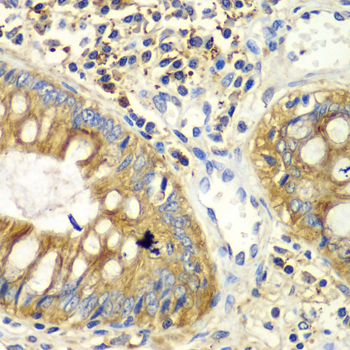
The antibody against PICK1 was raised in Rabbit using a synthetic peptide corresponding to a sequence within amino acids 300-400 of human PICK1 (NP_036539.1) as the immunogen. The polyclonal antibody exists as a isotype IgG, by affinity purification. This antibody has been validated on IHC-P, ELISA.
| Cat.No | ADA-06172A | Clonality | Polyclonal |
|---|---|---|---|
| Host Species | Rabbit | Target Name | PICK1 |
| Target Synonyms | PICK; PRKCABP; PICK1 | Form | Liquid |
| Species Reactivity | Human | Isotype | IgG |
| Storage Buffer | 50% Glycerol, PBS with 0.02% sodium azide, pH7.3. | Purification Method | Affinity purification |
| Application | ELISA, IHC-P |
| Immunogen Description | A synthetic peptide corresponding to a sequence within amino acids 300-400 of human PICK1 (NP_036539.1). | Target Species | Human |
|---|---|---|---|
| Immunogen Sequence | CRQEARARFSQMRKDVLEKMELLDQKHVQDIVFQLQRLVSTMSKYYNDCYAVLRDADVFPIEVDLAHTTLAYGLNQEEFTDGEEEEEEEDTAAGEPSRDTR | Uniprot ID | Q9NRD5 |
Uniprot Id
Q9NRD5
Target Species
Human
Target Name
PICK1
Target Full Name
PRKCA-binding protein
Target Function
Probable adapter protein that bind to and organize the subcellular localization of a variety of membrane proteins containing some PDZ recognition sequence. Involved in the clustering of various receptors, possibly by acting at the receptor internalization level. Plays a role in synaptic plasticity by regulating the trafficking and internalization of AMPA receptors. May be regulated upon PRKCA activation. May regulate ASIC1/ASIC3 channel. Regulates actin polymerization by inhibiting the actin-nucleating activity of the Arp2/3 complex; the function is competetive with nucleation promoting factors and is linked to neuronal morphology regulation and AMPA receptor (AMPAR) endocytosis. Via interaction with the Arp2/3 complex involved in regulation of synaptic plasicity of excitatory synapses and required for spine shrinkage during long-term depression (LTD). Involved in regulation of astrocyte morphology, antagonistic to Arp2/3 complex activator WASL/N-WASP function.
Target Subcellular Location
Cytoplasm, perinuclear region. Membrane; Peripheral membrane protein. Membrane; Lipid-anchor. Cell junction, synapse, postsynaptic density. Cell junction, synapse, synaptosome. Cytoplasm, cytoskeleton.
Target Tissue Specificity
Ubiquitous.
Target Research Area
Signal Transduction
Target Synonyms
dJ1039K5; MGC15204; OTTHUMP00000028509; PICK 1; Pick1; PICK1_HUMAN; PRKCA binding protein; PRKCA-binding protein; PRKCABP; Protein interacting with C kinase 1; Protein interacting with PRKCA; Protein interacting with PRKCA 1; Protein kinase C alpha binding protein; Protein kinase C-alpha-binding protein; Protein that interacts with C kinase 1
Target Background
The protein encoded by this gene contains a PDZ domain, through which it interacts with protein kinase C, alpha (PRKCA). This protein may function as an adaptor that binds to and organizes the subcellular localization of a variety of membrane proteins. It has been shown to interact with multiple glutamate receptor subtypes, monoamine plasma membrane transporters, as well as non-voltage gated sodium channels, and may target PRKCA to these membrane proteins and thus regulate their distribution and function. This protein has also been found to act as an anchoring protein that specifically targets PRKCA to mitochondria in a ligand-specific manner. Three transcript variants encoding the same protein have been found for this gene.
Notification