-
Chinese (Simplified)
-
English
-
German
-
Korean
-
Spanish
Chinese (Simplified)
English
German
Korean
Spanish
Sign up for an account to enjoy easy online shopping and instant order tracking.
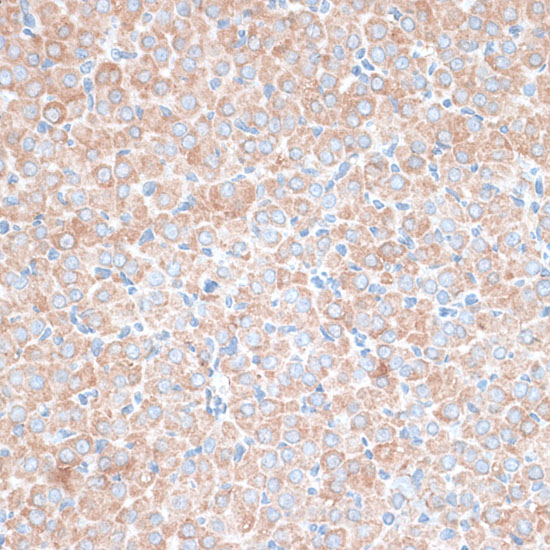
The antibody against PMEPA1 was raised in Rabbit using the recombinant fusion protein containing a sequence corresponding to amino acids 173-252 of human PMEPA1 (NP_954638.1) as the immunogen. The polyclonal antibody exists as a isotype IgG, by affinity purification. This antibody has been validated on WB, IHC-P, ELISA.
| Cat.No | ADA-00206A | Clonality | Polyclonal |
|---|---|---|---|
| Host Species | Rabbit | Target Name | PMEPA1 |
| Target Synonyms | STAG1; TMEPAI; PMEPA1 | Form | Liquid |
| Species Reactivity | Human, Mouse, Rat | Isotype | IgG |
| Storage Buffer | 50% Glycerol, PBS with 0.01% thimerosal, pH7.3. | Purification Method | Affinity purification |
| Application | ELISA, WB, IHC-P |
| Immunogen Description | Recombinant fusion protein containing a sequence corresponding to amino acids 173-252 of human PMEPA1 (NP_954638.1). | Target Species | Human |
|---|---|---|---|
| Immunogen Sequence | PSSNSGISATCYGSGGRMEGPPPTYSEVIGHYPGSSFQHQQSSGPPSLLEGTRLHHTHIAPLESAAIWSKEKDKQKGHPL | Uniprot ID | Q969W9 |
Uniprot Id
Q969W9
Target Species
Human
Target Name
PMEPA1
Target Full Name
Protein TMEPAI
Target Function
Functions as a negative regulator of TGF-beta signaling and thereby probably plays a role in cell proliferation, differentiation, apoptosis, motility, extracellular matrix production and immunosuppression. In the canonical TGF-beta pathway, ZFYVE9/SARA recruits the intracellular signal transducer and transcriptional modulators SMAD2 and SMAD3 to the TGF-beta receptor. Phosphorylated by the receptor, SMAD2 and SMAD3 then form a heteromeric complex with SMAD4 that translocates to the nucleus to regulate transcription. Through interaction with SMAD2 and SMAD3, LDLRAD4 may compete with ZFYVE9 and SMAD4 and prevent propagation of the intracellular signal. Also involved in down-regulation of the androgen receptor (AR), enhancing ubiquitination and proteasome-mediated degradation of AR, probably by recruiting NEDD4.
Target Subcellular Location
Early endosome membrane; Single-pass membrane protein. Golgi apparatus membrane; Single-pass membrane protein.
Target Protein Families
PMEPA1 family
Target Tissue Specificity
Highest expression in prostate. Also expressed in ovary.
Target Synonyms
PMEPA_HUMAN; PMEPA1; Prostate transmembrane protein; androgen induced 1; Solid tumor associated 1 protein; Solid tumor-associated 1 protein; STAG1; TMEPAI; Transmembrane prostate androgen induced protein ; Transmembrane prostate androgen-induced protein; Transmembrane; prostate androgen induced RNA
Target Background
This gene encodes a transmembrane protein that contains a Smad interacting motif (SIM). Expression of this gene is induced by androgens and transforming growth factor beta, and the encoded protein suppresses the androgen receptor and transforming growth factor beta signaling pathways though interactions with Smad proteins. Overexpression of this gene may play a role in multiple types of cancer. Alternatively spliced transcript variants encoding multiple isoforms have been observed for this gene.
Notification