-
Chinese (Simplified)
-
English
-
German
-
Korean
-
Spanish
Chinese (Simplified)
English
German
Korean
Spanish
Sign up for an account to enjoy easy online shopping and instant order tracking.
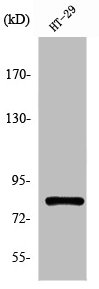
The antibody against PNN was raised in rabbit using the Synthesized peptide derived from the Internal region of Human Pinin. as the immunogen. This antibody exists as a non-conjugated isotype IgG. The antibody was affinity-purified from rabbit antiserum by affinity-chromatography using epitope-specific immunogen. This antibody has been validated on WB, ELISA.
$167.00
| Cat.No | ADC-37844A | Clonality | Polyclonal |
|---|---|---|---|
| Host Species | Rabbit | Target Name | PNN |
| Form | Liquid | Species Reactivity | Human, Mouse |
| Isotype | IgG | Storage Buffer | 0.5% BSA and 0.02% sodium azide., Liquid in PBS containing 50% glycerol |
| Purification Method | The antibody was affinity-purified from rabbit antiserum by affinity-chromatography using epitope-specific immunogen. | Conjugate | Non-conjugated |
| Application | ELISA, WB | Storage | Upon receipt |
| Immunogen Description | Synthesized peptide derived from the Internal region of Human Pinin. | Target Species | Human |
|---|---|---|---|
| Immunogen Sequence | Complete sequences for the immunogen, target protein, and peptides are available upon request. | Uniprot ID | Q9H307 |
Uniprot Id
Q9H307
Target Species
Human
Target Name
PNN
Target Full Name
Pinin
Target Function
Transcriptional activator binding to the E-box 1 core sequence of the E-cadherin promoter gene; the core-binding sequence is 5'CAGGTG-3'. Capable of reversing CTBP1-mediated transcription repression. Auxiliary component of the splicing-dependent multiprotein exon junction complex (EJC) deposited at splice junction on mRNAs. The EJC is a dynamic structure consisting of core proteins and several peripheral nuclear and cytoplasmic associated factors that join the complex only transiently either during EJC assembly or during subsequent mRNA metabolism. Participates in the regulation of alternative pre-mRNA splicing. Associates to spliced mRNA within 60 nt upstream of the 5'-splice sites. Component of the PSAP complex which binds RNA in a sequence-independent manner and is proposed to be recruited to the EJC prior to or during the splicing process and to regulate specific excision of introns in specific transcription subsets. Involved in the establishment and maintenance of epithelia cell-cell adhesion. Potential tumor suppressor for renal cell carcinoma.
Target Subcellular Location
Nucleus speckle. Cell junction, desmosome. Note=Cell-cell contact area, predominantly desmosome of intercellular adherens junction. Not a nucleocytoplasmic shuttling protein.
Target Protein Families
Pinin family
Target Tissue Specificity
Expressed in placenta, lung, liver, kidney, pancreas, spleen, thymus, prostate, testis, ovary, small intestine, colon, heart, epidermis, esophagus, brain and smooth and skeletal muscle. Expressed strongly in melanoma metastasis lesions and advanced primar
Target Synonyms
140 kDa nuclear and cell adhesion-related phosphoprotein; Desmosome-associated protein; Domain-rich serine protein; DRS; DRS protein; DRSP; Melanoma metastasis clone A protein; MEMA; Nuclear protein SDK3; Pinin; PININ_HUMAN; PNN; SR like protein; SR-like protein
Target Background
Enables RNA binding activity. Predicted to be involved in cell adhesion and mRNA splicing, via spliceosome. Predicted to act upstream of or within cell-cell adhesion. Located in nuclear speck. Part of catalytic step 2 spliceosome. Colocalizes with exon-exon junction complex.
Notification