-
Chinese (Simplified)
-
English
-
German
-
Korean
-
Spanish
Chinese (Simplified)
English
German
Korean
Spanish
Sign up for an account to enjoy easy online shopping and instant order tracking.
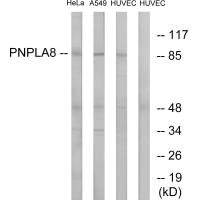
The antibody against PNPLA8 was raised in rabbit using the Synthesized peptide derived from internal of Human PNPLA8. as the immunogen. The antibody was affinity-purified from rabbit antiserum by affinity-chromatography using epitope-specific immunogen. This antibody has been validated on ELISA, WB.
$297.00
| Cat.No | ADC-41393A | Clonality | Polyclonal |
|---|---|---|---|
| Host Species | Rabbit | Target Name | PNPLA8 |
| Form | Liquid | Species Reactivity | Human, Mouse |
| Storage Buffer | PH 7.4, 0.02% sodium azide and 50% glycerol., 150mM NaCl, Rabbit IgG in phosphate buffered saline (without Mg2+ and Ca2+) | Purification Method | The antibody was affinity-purified from rabbit antiserum by affinity-chromatography using epitope-specific immunogen. |
| Application | ELISA, WB | Storage | Upon receipt |
| Immunogen Description | Synthesized peptide derived from internal of Human PNPLA8. | Target Species | Human |
|---|---|---|---|
| Immunogen Sequence | Complete sequences for the immunogen, target protein, and peptides are available upon request. | Uniprot ID | Q9NP80 |
Uniprot Id
Q9NP80
Target Species
Human
Target Name
PNPLA8
Target Full Name
Calcium-independent phospholipase A2-gamma
Target Function
Calcium-independent and membrane-bound phospholipase, that catalyzes the esterolytic cleavage of fatty acids from glycerophospholipids to yield free fatty acids and lysophospholipids, hence regulating membrane physical properties and the release of lipid second messengers and growth factors. Hydrolyzes phosphatidylethanolamine, phosphatidylcholine and probably phosphatidylinositol with a possible preference for the former. Has also a broad substrate specificity in terms of fatty acid moieties, hydrolyzing saturated and mono-unsaturated fatty acids at nearly equal rates from either the sn-1 or sn-2 position in diacyl phosphatidylcholine. However, has a weak activity toward polyunsaturated fatty acids at the sn-2 position, and thereby favors the production of 2-arachidonoyl lysophosphatidylcholine, a key branch point metabolite in eicosanoid signaling. On the other hand, can produce arachidonic acid from the sn-1 position of diacyl phospholipid and from the sn-2 position of arachidonate-containing plasmalogen substrates. Therefore, plays an important role in the mobilization of arachidonic acid in response to cellular stimuli and the generation of lipid second messengers. Can also hydrolyze lysophosphatidylcholine. In the mitochondrial compartment, catalyzes the hydrolysis and release of oxidized aliphatic chains from cardiolipin and integrates mitochondrial bioenergetics and signaling. It is essential for maintaining efficient bioenergetic mitochondrial function through tailoring mitochondrial membrane lipid metabolism and composition.
Target Involvement
Mitochondrial myopathy with lactic acidosis (MMLA)
Target Subcellular Location
Endoplasmic reticulum membrane; Single-pass membrane protein. Mitochondrion membrane; Single-pass membrane protein. Peroxisome membrane; Single-pass membrane protein.
Target Tissue Specificity
Expressed in parenchymal tissues including heart, skeletal muscle, placenta, brain, liver and pancreas. Also expressed in bronchial epithelial cells and kidney. Highest expression is observed in skeletal muscle and heart.
Target Synonyms
PNPLA8; IPLA22; IPLA2G; BM-043; Calcium-independent phospholipase A2-gamma; Intracellular membrane-associated calcium-independent phospholipase A2 gamma; iPLA2-gamma; PNPLA-gamma; Patatin-like phospholipase domain-containing protein 8; iPLA2-2
Notification