-
Chinese (Simplified)
-
English
-
German
-
Korean
-
Spanish
Chinese (Simplified)
English
German
Korean
Spanish
Sign up for an account to enjoy easy online shopping and instant order tracking.
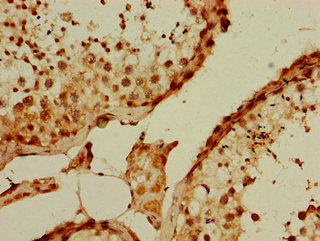
The antibody against PQBP1 was raised in rabbit using the Recombinant Human Polyglutamine-binding protein 1 protein (2-265AA) as the immunogen. This antibody exists as a non-conjugated isotype IgG, purified by protein G with a purity greater than 95%. This antibody has been validated on ELISA, IHC.
$299.00
| Cat.No | ADC-13471A | Clonality | Polyclonal |
|---|---|---|---|
| Host Species | Rabbit | Target Name | PQBP1 |
| Form | Liquid | Species Reactivity | Human |
| Isotype | IgG | Storage Buffer | 0.01M PBS, 0.03% Proclin 300; Constituents: 50% Glycerol, PH 7.4 |
| Purification Method | >95%, Protein G purified | Conjugate | Non-conjugated |
| Application | ELISA, IHC | Storage | Upon receipt |
| Immunogen Description | Recombinant Human Polyglutamine-binding protein 1 protein (2-265AA) | Target Species | Human |
|---|---|---|---|
| Immunogen Sequence | Complete sequences for the immunogen, target protein, and peptides are available upon request. | Uniprot ID | O60828 |
Uniprot Id
O60828
Target Species
Human
Target Name
PQBP1
Target Full Name
Polyglutamine-binding protein 1
Target Function
Intrinsically disordered protein that acts as a scaffold, and which is involved in different processes, such as pre-mRNA splicing, transcription regulation, innate immunity and neuron development. Interacts with splicing-related factors via the intrinsically disordered region and regulates alternative splicing of target pre-mRNA species. May suppress the ability of POU3F2 to transactivate the DRD1 gene in a POU3F2 dependent manner. Can activate transcription directly or via association with the transcription machinery. May be involved in ATXN1 mutant-induced cell death. The interaction with ATXN1 mutant reduces levels of phosphorylated RNA polymerase II large subunit. Involved in the assembly of cytoplasmic stress granule, possibly by participating in the transport of neuronal RNA granules. Also acts as an innate immune sensor of infection by retroviruses, such as HIV, by detecting the presence of reverse-transcribed DNA in the cytosol. Directly binds retroviral reverse-transcribed DNA in the cytosol and interacts with CGAS, leading to activate the cGAS-STING signaling pathway, triggering type-I interferon production.
Target Involvement
Renpenning syndrome 1 (RENS1)
Target Subcellular Location
Nucleus. Nucleus speckle. Cytoplasmic granule.
Target Tissue Specificity
Widely expressed with high level in heart, skeletal muscle, pancreas, spleen, thymus, prostate, ovary, small intestine and peripheral blood leukocytes.
Target Synonyms
38 kDa nuclear protein containing a WW domain; Mental retardation; X linked 55; MRX55; MRXS3; MRXS8; Npw38; Nuclear protein containing WW domain 38 kD; OTTHUMP00000025808; Polyglutamine binding protein 1; Polyglutamine tract binding protein 1; Polyglutamine tract-binding protein 1; Polyglutamine-binding protein 1; PQBP 1; PQBP-1; PQBP1; PQBP1_HUMAN; RENS1; SHS; Sutherland Haan X linked mental retardation syndrome
Target Background
This gene encodes a nuclear polyglutamine-binding protein that is involved with transcription activation. The encoded protein contains a WW domain. Mutations in this gene have been found in patients with Renpenning syndrome 1 and other syndromes with X-linked cognitive disability. Multiple alternatively spliced transcript variants that encode different protein isoforms have been described for this gene.
Notification